
Fuel Delivery Glossary: 50 Terms Explained
The words on your quotes, tickets and invoices, in plain language. Every term has its own link, and each one points to the guide that covers it in depth.
A fuel delivery glossary defines the words on your quotes, tickets and invoices. The ones buyers ask about most: wet hosing (fueling each vehicle from the truck where it's parked), rack price (the terminal's daily wholesale price), ULSD (diesel with 15 ppm sulfur or less) and dyed diesel (sold without highway tax, for off-road use only).
Diesel fuel terms: types and grades
- ULSD (ultra-low sulfur diesel)
- Diesel with 15 parts per million of sulfur or less, the S15 grade in ASTM D975. It's the U.S. standard for highway and nonroad diesel, so clear and dyed diesel are both ULSD today. Low sulfur is what lets particulate filters and other exhaust catalysts work. See what is ULSD?
- No. 2 diesel (#2)
- The standard year-round grade that trucks, equipment and generators burn most of the year. It carries more energy per gallon than #1, but untreated it starts to cloud at around 6–14°F. See #1 vs #2 diesel.
- No. 1 diesel (#1)
- A lighter, thinner grade close to kerosene. It carries less wax, so it stays fluid in cold that would plug a filter on #2, but it has a few percent less energy per gallon and costs more. Its main job is winter blending. See #1 in winter blends and kerosene vs diesel.
- Winter diesel (winterized diesel)
- Not a separate grade. It's #2 blended with #1, treated with cold-flow additives, or both. Each 10% of #1 lowers the cloud point about 3°F. Ask for the cloud point of what you're buying, not just the name. See how to prevent diesel gelling.
- Clear diesel (on-road diesel)
- Undyed diesel sold with federal and state highway taxes included, for anything registered for public roads. See on-road diesel delivery and federal excise tax.
- Dyed diesel (off-road or red diesel)
- The same ULSD, dyed red (Solvent Red 164 under IRS rules) to mark it as sold without federal highway excise tax. It's for nontaxable uses only, such as off-road equipment, generators and farming. Anything registered for public roads takes clear diesel. See dyed vs clear diesel and off-road diesel delivery.
- Renewable diesel (R99, R100, HVO)
- Diesel made by hydrotreating fats and oils into the same kind of hydrocarbons as petroleum diesel. It meets ASTM D975, so it runs as a drop-in fuel and blends at any ratio. The R-number is the renewable share; HVO (hydrotreated vegetable oil) is the name used in Europe. R99 isn't at every terminal; where FuelGo can't pull it locally, it ships by rail or barge. See what is HVO? and R99 renewable diesel.
- Biodiesel (B100, B5, B20)
- A different fuel: fatty acid methyl esters made by transesterification, with B100 under ASTM D6751. The number is the biodiesel share. Up to B5 counts as ordinary diesel under D975, and B20 is covered by D7467. Check your engine maker's approval before going above B5. See biodiesel vs diesel and renewable diesel vs biodiesel.
Fuel delivery terms: wet hosing, tank wagons and transports
- Wet hosing (mobile fleet fueling)
- Fueling straight from a fuel truck into each vehicle or machine where it's parked, usually overnight or between shifts. No station runs and no storage tank. Gallons are recorded for each unit: FuelGo drivers scan each unit at the meter, and you get a fleet report by vehicle. See what is wet hosing? and mobile fleet fueling.
- Tank wagon
- The industry name for a small fuel delivery truck, particularly one that carries less than 5,000 gallons (PEI). It handles drops into site tanks, generators and equipment, and sites where a full transport isn't needed or can't fit. See on-site fuel delivery.
- Transport (transport load)
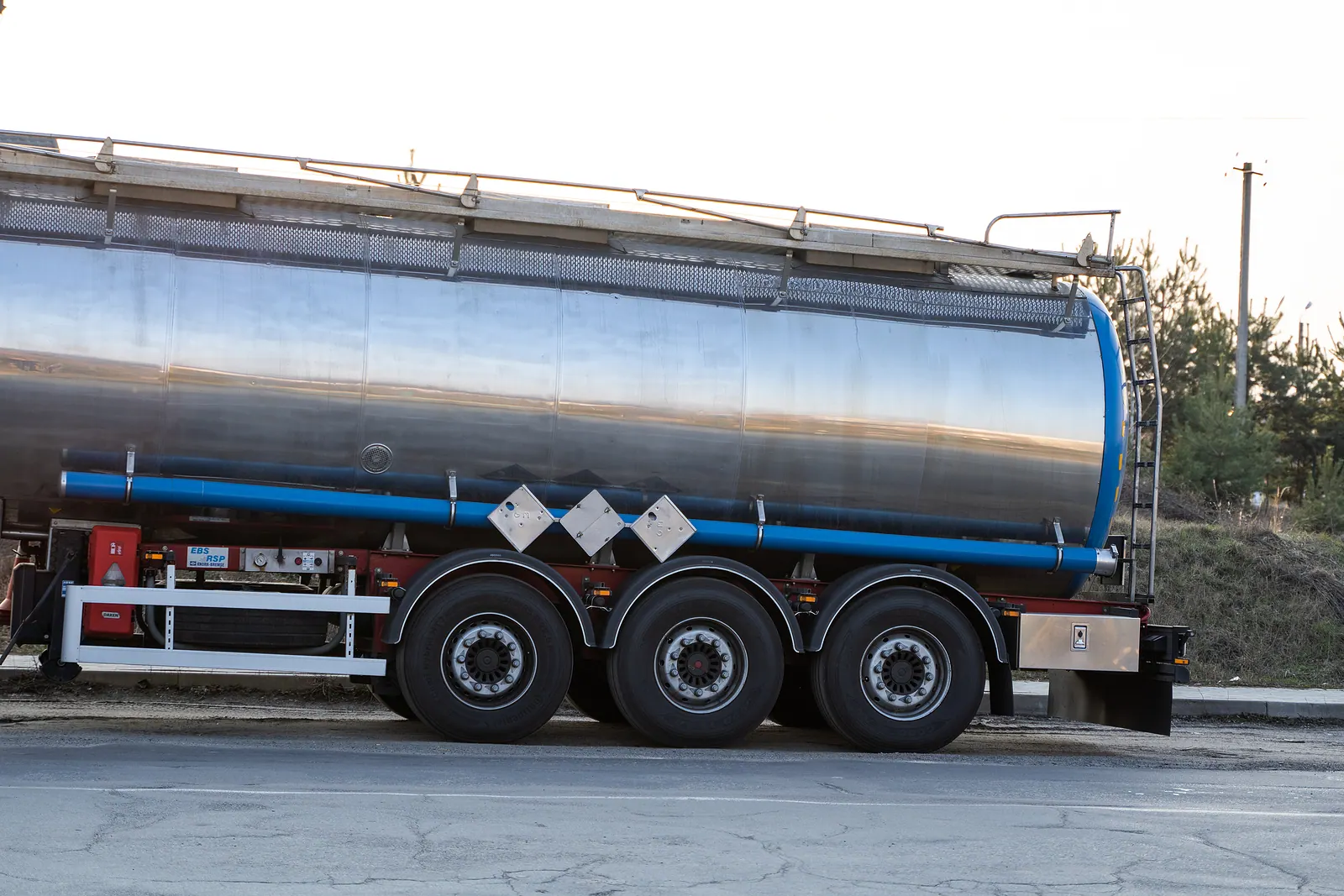
- A tractor-trailer tanker load hauled from the terminal to one large tank. OPIS puts a typical rack truckload at about 8,000 gallons. FuelGo delivers transport loads up to 7,500 gallons. See bulk fuel delivery.
- Drop
- A single delivery into a tank. The Texas Comptroller's motor fuel glossary defines it as "a bulk delivery of fuel from a transport truck to a service station or other storage." Drop size is the gallons per delivery; FuelGo's drops run from 20 to 4,400 gallons.
- Keep-full program (automatic delivery)
- A standing arrangement where the supplier tops up your tank on a schedule or when monitoring shows it's low, so nobody has to remember to order. Common for standby generators and fleet yard tanks. See generator fuel delivery and tank monitoring.
- Combustible liquid (hazmat)
- For highway transport, a flammable liquid with a flash point at or above 100°F can be reclassed as a combustible liquid; diesel can be, gasoline can't. A combustible liquid in a container of 119 gallons or less isn't subject to the federal hazmat rules unless it's a hazardous substance, waste or marine pollutant (49 CFR 173.150). See how much fuel you can haul without hazmat.
Fuel pricing terms: rack price, OPIS, futures and taxes
- Rack price (terminal, rack)
- A terminal is a storage and distribution facility supplied by pipeline or vessel. The rack is the equipment that loads fuel into trucks and rail cars (IRS). The rack price is the wholesale price a supplier posts for fuel loaded there. It moves daily, and your delivered price adds freight, taxes and the supplier's margin. See what is the rack price of diesel?
- OPIS (Oil Price Information Service)
- A price reporting agency. It collects suppliers' posted rack prices at about 1,500 U.S. terminals in nearly 400 market locations and publishes lows, highs and averages that many fuel contracts use as their index. DTN collects rack prices too. See OPIS and rack pricing.
- NY Harbor ULSD futures (NYMEX, HO)
- The benchmark U.S. diesel futures contract: 42,000 gallons (1,000 barrels) of ULSD for delivery in New York Harbor in a coming month, traded on CME's NYMEX under the code HO. It's the market's daily read on wholesale diesel. See the diesel price report and futures and spot.
- Basis (and spot price)
- A spot price is for fuel delivered now at a trading hub such as New York Harbor or the Gulf Coast. Basis is the difference between a spot or cash price and the nearest futures contract (CFTC). Pipeline space, refinery outages and local supply move it, which is why regions don't always move together. See how basis works.
- Rack-plus pricing (index pricing)
- A price set as a published rack figure, such as an OPIS average at a named terminal on the delivery date, plus a per-gallon differential agreed up front, with taxes on top. To check an invoice, you need the index, terminal, pricing date and differential in writing. See pricing structures.
- Fixed-price contract
- One price per gallon for an agreed volume and term. If the market rises, your price holds. If it falls, you still pay the fixed price. You're buying budget certainty, not guaranteed savings. FuelGo prices fixed contracts off NYMEX NY Harbor ULSD futures. See fixed-price diesel contracts.
- Federal excise tax (and LUST tax)
- 24.4¢ a gallon on clear diesel: 24.3¢ of excise plus the 0.1¢ Leaking Underground Storage Tank (LUST) tax. It's imposed when fuel leaves the terminal rack and rides down to your invoice. Dyed diesel that meets the IRS dyeing rules pays only the 0.1¢ LUST tax. State taxes come on top. See diesel taxes by state.
- Nontaxable use credit (off-road tax refund)
- If you paid federal tax on clear diesel and burned it in a nontaxable use, such as off-highway business use (generators, compressors, forklifts, earthmovers) or farming, you may be able to claim the tax back: $0.243 a gallon in the IRS's own example. Claims go on Form 4136 with your income tax return, or on Form 8849 for a periodic refund. See off-road diesel tax refunds.
Tax terms here are general definitions, not tax advice. Rules and rates change; check with your tax adviser before you file a claim.
Tickets & measurementDelivery ticket and measurement terms
- Delivery ticket
- The record of one delivery, printed or issued from the truck's meter. NIST Handbook 44 requires vehicle-mounted meters to record every sale and the customer to get a copy at delivery. Check the product, the site, the gallons and that the meter started at zero. See how to read a fuel delivery ticket.
- Meter zero and tolerance
- Under Handbook 44, the truck's meter must be returned to zero immediately before each delivery begins. In service it may read up to 0.3% off on large meters (over 30 gallons a minute) or 0.5% on smaller motor-fuel meters, in either direction: about 3 to 5 gallons on 1,000. See meter tolerance.
- Short delivery
- A delivery where the tank received less than the ticket says, by more than the meter's tolerance and your gauge's precision can explain. Gauge before and after with the tank maker's chart, watch the meter start at zero, and look for a pattern across deliveries, not one reading. See checking for short deliveries.
- Gross vs. net gallons (temperature compensation)
- Gross gallons are what the meter measured at the fuel's actual temperature. Net gallons are corrected to 60°F, because fuel expands as it warms. Where a truck's meter compensates automatically, Handbook 44 requires the ticket or invoice to say the volume was adjusted to 60°F. Not every state allows temperature-compensated sales, so ask which basis your supplier bills on.
- API gravity (and weight per gallon)
- The petroleum industry's density scale: 141.5 divided by specific gravity at 60°F, minus 131.5 (EIA). Higher numbers mean lighter fuel. For everyday use, #2 diesel weighs about 7.1 pounds a gallon at 60°F. See how much diesel weighs.
Fuel tank and storage terms
- AST and UST (aboveground and underground storage tank)
- An AST sits on or above the ground. EPA counts a tank system as a UST when at least 10% of its combined volume, including connected underground piping, is underground. FuelGo rental tanks are aboveground. See fuel tank rental.
- Double-walled tank
- A tank inside a tank. The outer wall holds fuel if the inner wall leaks, and the space between them can be monitored for leaks. FuelGo's rental tanks for diesel, gasoline and DEF are double-walled, and many have lockable pump cabinets. See fuel tank rental.
- Day tank
- A small tank next to a generator that feeds the engine and is refilled from a larger main tank by a transfer pump, switched on and off by level floats. Fuel moved from the main tank to a day tank isn't fuel burned, which matters when you reconcile. See data center fuel monitoring.
- Sub-base tank (belly tank)
- A fuel tank built into the base the generator sits on. It's the simplest setup, but the frame limits its size and so its runtime. When it only buys hours, rental day tanks and auxiliary tanks extend it. See generator fuel delivery.
- Tank monitoring (telemetry)
- A sensor that reports the tank level remotely, to you and your supplier, so refills are scheduled off real consumption instead of a clipboard. Better systems also detect water and correct for temperature. On FuelGo-monitored tanks, you see the level on your phone, and so do we. See tank sensors.
Diesel fuel quality terms
- ASTM D975
- The U.S. standard specification for diesel fuel. It sets the grades (No. 1-D, No. 2-D and No. 4-D), the sulfur classes (S15, S500 and S5000) and limits such as cetane (40 minimum), lubricity, and water and sediment. Cold-flow properties are left to buyer and seller to agree for the season and region. See diesel fuel grades.
- Cloud point (CFPP, pour point)
- Cloud point is the temperature at which wax crystals start to form and the fuel turns hazy, typically 6–14°F for untreated #2. Filters start plugging a few degrees lower, at the cold filter plugging point (CFPP), and the fuel stops pouring at its pour point. See what temp does diesel gel?
- Cetane number
- A measure of how quickly diesel ignites once it's injected: the delay between injection and combustion. Low cetane means hard cold starts and white smoke. D975 sets a minimum of 40; the model premium diesel definition calls for 47. See cetane and premium diesel.
- Lubricity (HFRR)
- The fuel's ability to protect the pump and injector parts it lubricates as it flows. Refining sulfur down to 15 ppm strips the compounds that provided it, so ULSD gets a lubricity additive to pass D975's limit: a wear scar no larger than 520 microns on the HFRR test (ASTM D6079). See diesel lubricity.
- Free water (water bottoms)
- Water that has separated from the fuel. At 8.34 pounds a gallon against about 7.1 for diesel, it sinks to the tank bottom. It gets in through condensation, rain at loose caps and vents, and wet deliveries. D975 caps water and sediment at 0.05% by volume. See water in diesel.
- Microbial contamination (diesel bug)
- Bacteria and fungi that grow where fuel meets water at the bottom of a tank, forming sludge and slime that plug filters and feed corrosion. Removing the water is where the fix starts. See microbial contamination.
- Fuel polishing
- Pumping fuel out of a tank through water separation and filtration and back in, usually while the tank stays in service. It removes free water, sediment and loose microbial debris. It cleans the fuel, not the tank. See fuel polishing vs tank cleaning and fuel polishing service.
- Tank cleaning
- Taking the fuel out and removing what polishing can't reach: sludge on the floor, biofilm on the walls and scale. Fuel that has oxidized gets neither; it gets pumped out and replaced. A lab test on a bottom sample tells you which one you need. See when to clean the tank.
DEF terms: diesel exhaust fluid, ISO 22241 and SCR
- DEF (diesel exhaust fluid, AdBlue)
- A clear, non-flammable solution of 32.5% high-purity urea and 67.5% deionized water, sold in Europe as AdBlue. It goes in its own tank, usually behind a blue cap, never in the fuel tank. FuelGo delivers it in 2.5-gallon jugs, 55-gallon drums, 275- and 330-gallon totes and bulk tank fills. See what is DEF?, DEF vs AdBlue and bulk DEF delivery.
- ISO 22241
- The international standard for DEF (called AUS 32 in the standard). Its parts cover quality requirements, test methods, and handling, transport and storage. Contaminant limits are tight, which is why DEF can't be cut or topped up with water. See can you dilute DEF with water?
- SCR (selective catalytic reduction)
- The exhaust system that sprays DEF into hot exhaust ahead of a catalyst, where it turns nitrogen oxides (NOx) into nitrogen and water. An engine with SCR needs a steady DEF supply. See what does DEF do? and DEF in the diesel tank.
- DEF dosing rate
- DEF used as a share of diesel burned. Most engine makers put it at about 2–3%, or 2 to 3 gallons of DEF per 100 gallons of diesel. Some current engines and large Tier 4 Final generators run higher. Start with your engine maker's figure, then measure your own. See how much DEF per gallon of diesel and the DEF consumption calculator.
- DEF freezing point
- DEF starts to freeze at 12°F (−11°C). Freezing doesn't hurt it: thawed DEF is back in spec, and trucks built for DEF have heated tanks and lines. Never add antifreeze or anything else to it. Heat, not cold, is what shortens its shelf life. See does DEF freeze? and DEF storage and shelf life.
Generator fuel terms
- Burn rate (fuel consumption)
- How many gallons an hour a generator burns, set by its size and load. Across 28 manufacturer spec sheets, the median is about 0.074 gallons an hour per kW at full load and 0.059 at 75% load, so a 500 kW set at 75% burns roughly 25 gallons an hour. Your spec sheet has the exact figure. See the generator fuel consumption chart and generator fuel calculator.
- Runtime (usable fuel)
- How long a generator can run on the fuel on hand: usable gallons divided by the burn rate at your actual load. Count usable fuel, not tank capacity, because the pickup sits above the tank floor, and count every tank that feeds the set. See how much diesel a data center needs.
- Wet stacking
- Unburned fuel and carbon building up in a diesel engine's exhaust after long runs at light or no load, when the engine never gets hot enough to burn all its fuel. Higher load, or a load bank, burns it off. See wet stacking.
- Load bank test
- Running a generator against a load bank, test equipment that absorbs the set's output and turns it into heat, so you can load it to its rating without the building. It proves the engine and its cooling, fuel and exhaust systems, and it burns real fuel, so plan a top-off afterward. See load bank testing.
Need diesel delivered?
FuelGo delivers dyed off-road and clear on-road diesel, gasoline, DEF and R99 renewable diesel nationwide. That's wet-hose fleet fueling, on-site drops of 20 to 4,400 gallons into tanks, generators and equipment, and transport loads up to 7,500 gallons. Add generator fueling, emergency fuel, tank rentals, tank monitoring, and fuel polishing, tank cleaning and lab fuel testing when you need them.
Dispatch runs 24/7/365, and a dispatcher replies within the hour. Get a delivered quote or call 800-720-4546.
Common questionsFuel delivery terms FAQ
What does wet hosing mean?
What is the rack price of diesel?
What does OPIS stand for in fuel pricing?
What's the difference between clear and dyed diesel?
What does ULSD stand for?
What is the difference between gross and net gallons?
What is the difference between a tank wagon and a transport?
Sources: DieselNet, U.S. diesel fuel standards (ASTM D975 grades, cetane, lubricity, water and sediment, biodiesel limits; premium diesel) · IRS Publication 510, Excise Taxes (terminal, rack, $0.244 rate, LUST, dyeing rules, nontaxable uses) · IRS, Instructions for Form 4136 · NY Harbor ULSD futures (HO) contract specifications · CFTC glossary, basis · OPIS, gasoline and diesel rack prices · OPIS glossary, renewable diesel (R99) · U.S. DOE AFDC, renewable diesel · U.S. DOE AFDC, biodiesel blends · NIST Handbook 44 (2026), 3.31 Vehicle-Tank Meters (Table 1, S.2.5, UR.2.1, UR.2.2, UR.2.5) · U.S. EIA glossary, API gravity · 49 CFR 173.150 · 49 CFR 171.8, bulk packaging · PEI glossary, tankwagon · Texas Comptroller, motor fuels glossary (drop) · U.S. EPA, learn about USTs · Modern Welding, UL 142 double-wall tanks · Portlandia Electric Supply, generator fuel transfer and day tanks · Detroit fuels brochure, cetane number · Detroit fuels brochure, cloud point · ASTM D6371 cold filter plugging point (summary) · USGS, weight of water · AmSpec, microbial contamination in petroleum products · Old World Industries, DEF FAQ (32.5% urea, ISO 22241, 12°F, SCR) · ISO 22241-3:2017 (preview) · Caterpillar, wet stacking · Avtron Power Solutions, load bank basics