
How to Read a Fuel Delivery Ticket: Fields, Meters and Short Deliveries
The ticket is your only record of what went into the tank. Watch the meter start at zero, check the product and site, and compare the gallons with your gauge.
A fuel delivery ticket should name the seller and buyer, the date, the product, the gallons delivered and the price per gallon. Check that the meter started at zero, that the product and site are right, and that the gallons fit the tank. Then compare the ticket with your before-and-after gauge readings.
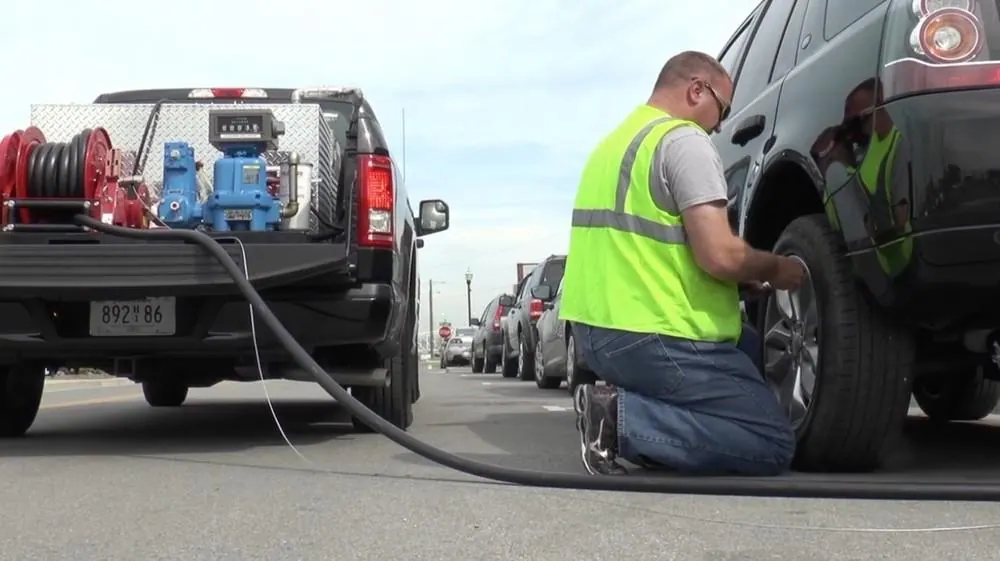
What's on a fuel delivery ticket, and what to check
Weights and measures law is set state by state. All 50 states adopt NIST Handbook 44, the national code for commercial meters and their tickets (some use an older edition), and many base their sales rules on NIST Handbook 130. Handbook 130's model law says every bulk sale where buyer and seller aren't both there to watch the measurement, and every bulk heating fuel delivery, must come with a delivery ticket. Here is what that ticket carries and what to look for on each line.
| Line on the ticket | Basis | What to check |
|---|---|---|
| Buyer and seller, with addresses | HB 130 model law | The right account and the right site. With several job sites or yards, a ticket billed to the wrong address is the most common mix-up. |
| Date delivered | HB 130 model law | Matches when the truck was actually there: gate log, camera, or the person who received it. |
| Product | HB 130 model law | Named in the most descriptive terms practical, including any quality claim made in the sale. Dyed or clear, ULSD, a biodiesel blend, R99, a winter blend. Wrong product in the wrong tank is a bigger problem than a short count; see dyed vs. clear diesel. |
| Quantity delivered | HB 130 model law | The meter's reading for this delivery, in gallons. Compare it with your gauge and with what the tank could physically take. |
| Price per gallon and total | HB 130 / HB 44 | Unit price is required unless buyer and seller agree otherwise. A computing meter that prints a total must also print the quantity and the price per gallon. Check the math and that the price matches your quote or contract. |
| Taxes and fees | Usually on the invoice | Road taxes belong on clear diesel. Dyed diesel skips the 24.3¢ federal excise and, in most states, state motor fuel tax. Rates are in our diesel taxes by state table. |
| Ticket number, truck and meter ID, signature | Common practice | Not in the model law, but they tie a ticket to one truck and one meter, which is what an inspector tests. Some states add rules: New York requires home heating oil tickets to be serially numbered, with a copy kept for a year. |
HB 130 = NIST Handbook 130, Uniform Weights and Measures Law, Section 17. HB 44 = NIST Handbook 44, sections 3.31 (vehicle-tank meters) and 1.10 (general code). Your state's adopted version may differ.
You can ask for it electronically. Handbook 44 says the required ticket is given to you in hard copy unless you say otherwise, and a system that can issue electronic receipts may send it to your phone or computer instead of, or as well as, paper. You may also be offered the option of no ticket at all. For commercial fuel, always take one.
The meterThe meter: zeroing, seals and how accurate it has to be
It starts at zero, every time
Handbook 44 requires the indicator, and the printer if it resets, to be returned to zero immediately before each delivery begins, once the pump is running and product has reached the meter. The indicator can't be reset during a delivery. Electronic registers must lock out the next delivery until they're zeroed, and a delivery with no flow for three minutes has to be closed out first.
The ticket goes in at the start
On a meter with a ticket printer, the ticket can't be inserted until immediately before the delivery, and never while the truck is moving on a public road. A ticket that already shows gallons when the hose comes out isn't this delivery's ticket.
Calibration is sealed
The meter's calibration must be protected by a physical security seal or an electronic audit trail, so it can't be adjusted without leaving evidence. After a satisfactory test, Handbook 44 says the inspector should attach a seal or tag showing the product used in the test.
You're entitled to watch
A meter used in direct sales must be positioned so its indications can be read and the measurement watched from a reasonable customer position. Ask the driver where to stand.
How far off a delivery meter is allowed to be
| Meter class (HB 44 Table 1) | New or repaired meter | Meter in service | On 1,000 gallons |
|---|---|---|---|
| Petroleum, meters rated over 30 gal/min (Class 0.3) | ±0.15% | ±0.3% | Up to about 3 gal either way |
| Small motor-fuel meters, 1 to 30 gal/min (Class 0.5) | ±0.3% | ±0.5% | Up to about 5 gal either way |
Acceptance tolerance applies to new or newly repaired meters; maintenance tolerance applies in service. Tolerances apply to errors in both directions.
So a single delivery a couple of gallons light proves nothing. A pattern of light deliveries, ticket after ticket, does.
Multi-product trucks. When a truck runs different products through one hose, it can flush the line before your delivery so you don't get the last customer's fuel. Handbook 44 says the meter must be reset to zero after flushing and before your delivery starts, and the operator must keep a record of each flush (date, time, products and gallons) for 12 months. It also says dispensing products as different as gasoline and diesel through one meter isn't recommended.
Short deliveriesHow to catch a short fuel delivery
The meter tells you what left the truck. Your gauge tells you what arrived. A short delivery is a gap between the two that the meter's tolerance and your gauge's precision can't explain. The check takes five minutes:
- Gauge before the truck starts. Read the tank gauge or monitor, or stick the tank, and write it down. Convert inches to gallons with the chart for that tank model from its manufacturer, not a generic chart.
- Watch the meter start at zero. If there's a ticket printer, the ticket should go in now, not before.
- Gauge again right after the fill, once the fuel settles, with the same gauge or stick and the same chart.
- Compare the rise with the ticket. Allow for gauge precision and the meter's tolerance. Then file the ticket with your readings.
- Look for a pattern. One light reading is noise. The same gap on the same truck, delivery after delivery, is a question for your supplier.
Red flags on a delivery ticket
- More gallons than the tank could take. Ticket gallons larger than the empty space in the tank before the fill (tank capacity minus the starting gauge reading).
- A ticket already in the printer, or one that shows gallons before the hose was connected.
- Round numbers or handwritten gallons on a truck with a printing meter.
- The wrong product or wrong site on the ticket, or a product the invoice prices differently.
- Wet-hose fills that don't fit the machine: a fill larger than the unit's tank, or a fill on a unit that was down. Our fuel theft guide covers checking per-unit fills against hour meters.
If you think a delivery was short, take the ticket, your before-and-after readings and the tank chart to the supplier first. Many gaps turn out to be a misread gauge, the wrong tank chart or a ticket posted to the wrong tank. If it isn't resolved, contact your state weights and measures office, which enforces these meter rules and can inspect the truck's meter.
Ticket to invoiceFrom delivery ticket to invoice
The ticket records the delivery. The invoice bills it, often for several deliveries at once. Reconcile them before you pay:
- Every invoice line traces to a ticket: same date, site, product and gallons.
- The price basis matches your agreement. If you buy on an index or a fixed-price contract, check that the invoice uses that price. The diesel price report explains how published prices work.
- Taxes match the product. Clear diesel carries 24.4¢ a gallon in federal tax (the 24.3¢ excise plus the 0.1¢ LUST tax) plus state tax. Dyed diesel skips the excise. If you paid road tax on fuel you burned off-road, see off-road diesel tax refunds.
- Keep tickets with your fuel log. Tickets and invoices that show product and gallons are the records the IRS expects for fuel tax claims; Form 4136's instructions say to keep them at least 3 years. See off-road diesel compliance.
Tickets also feed your own planning. Gallons by site and date are what you need to set delivery frequency, size a tank or test a budget in the fleet fueling cost calculator or the generator fuel calculator.
FuelGoFuelGo delivery records
Every FuelGo delivery is a metered drop with a delivery record and an automated invoice, itemized by gallons, product and site. With mobile fleet fueling, every gallon is logged by vehicle, time and location, so you can check each fill against the unit's hours. Dyed and clear diesel go on the same account but are billed as separate line items, so your tax records stay clean. For bulk deliveries, records cover volume delivered, fuel specifications, tank information and compliance documentation, and invoices can feed ARIBA or COUPA.
We deliver clear on-road and dyed off-road diesel, gasoline, DEF and R99 renewable diesel, from 20 to 4,400 gallons per drop and in transport loads up to 7,500 gallons. If a tank's numbers don't add up because of water or sludge rather than the meter, fuel polishing, tank cleaning and lab fuel testing sort that out. Pay by credit card, ACH or check. Dispatch runs 24/7/365. Get a free quote or call 800-720-4546; a dispatcher replies within the hour.
Common questionsFuel delivery ticket FAQ
What is a fuel delivery ticket?
Can I get a fuel delivery ticket electronically?
Does a fuel truck meter have to start at zero?
How accurate does a delivery truck meter have to be?
Who checks fuel delivery truck meters?
What are red flags on a fuel delivery ticket?
What should I do if I think a fuel delivery was short?
How long should I keep fuel delivery tickets?
Sources: NIST Handbook 44 (2026), 3.31 Vehicle-Tank Meters (S.1.1.5, S.1.4.2, S.2.2, S.2.4, N.1, Table 1, UR.2.1–UR.2.3, UR.2.6) · NIST Handbook 44 (2026), 1.10 General Code (G-S.5.6, G-UR.3.3) · NIST, Handbooks and NCWM: a brief history (state adoption of HB 44) · NIST Handbook 130 (2026), Uniform Weights and Measures Law, Section 17 Sale from Bulk · New York Agriculture & Markets Law §192