
DEF Consumption
Calculator
Estimate how much Diesel Exhaust Fluid your fleet uses per day, week and month, and what it costs. Every rate is editable. Works for any fleet size.
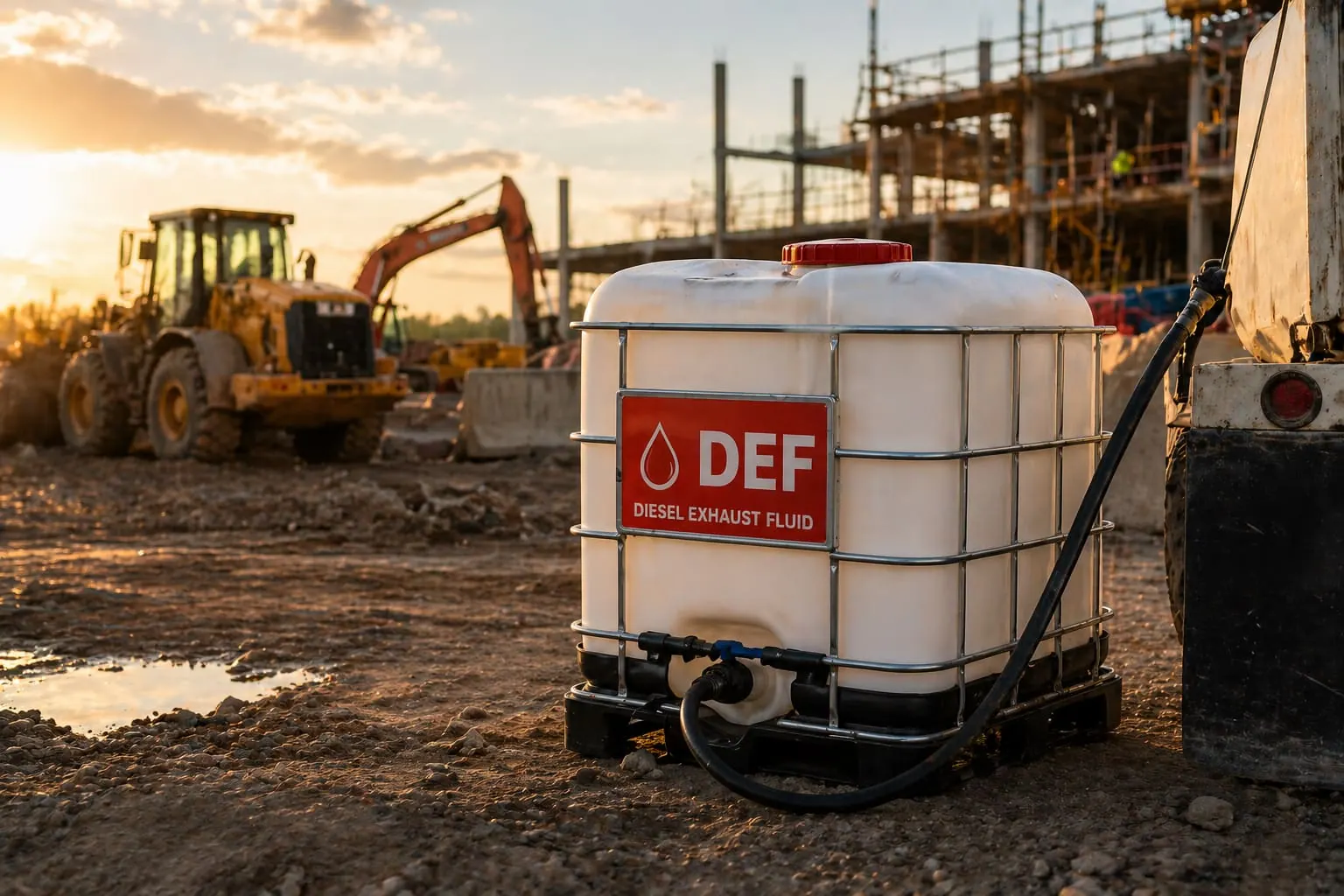
What is DEF? Diesel Exhaust Fluid (DEF) is a 32.5% solution of urea in deionized water, used by Selective Catalytic Reduction (SCR) systems. EPA set the NOx limits; engine makers widely adopted SCR to meet them, and an SCR engine derates when DEF runs out. Most makers put DEF use at about 2–3% of diesel burned. Cummins rates its X15 and Tier 4 Final engines at 3–5%, and large Tier 4 Final generators run 3.4–8% depending on load. Details by maker: how much DEF per gallon of diesel.
DEF Consumption Calculator
Enter your fleet details below — results update instantly
| Vehicle / Equipment Type | DEF rate | Quantity |
|---|---|---|
Semi / Class 8 Truck |
0 |
|
Medium-Duty Truck (Class 6–7) |
0 |
|
Pickup / Light Diesel (Class 3–5) |
0 |
|
Construction Equipment (Tier 4) |
0 |
|
Generator (Tier 4 Final, SCR) |
0 |
|
Bus / Coach |
0 |
|
Agricultural Equipment |
0 |
Diesel per day figures are examples; enter your own. Every DEF rate starts at 3% of diesel by volume, between Cat and Volvo's 2–3% guidance and Cummins' 3–5% for its X15 and Tier 4 Final engines. Use your engine maker's figure or your measured ratio. Large Tier 4 Final generators run 3.4–8% depending on load (Cat 3516C); many standby sets have no SCR and use no DEF.
How much DEF does a diesel engine use?
Diesel Exhaust Fluid (DEF) is dosed in proportion to the diesel an SCR engine burns, so the rate is quoted as a percent of diesel by volume. Most engine makers put it at about 2–3%: Cat and Volvo at 2–3%, John Deere at 1–3%. Cummins rates its X15 and Tier 4 Final engines at 3–5%, and large Tier 4 Final generators run 3.4–8% depending on load. Cummins' own example is a Class 8 truck burning 15,000 gallons of diesel a year: at 5% that's 750 gallons of DEF, at 3% it's 450, and at 2% it's 300. The full breakdown by maker is in how much DEF per gallon of diesel.
EPA's 2010 standards for heavy-duty on-road engines, and the phased-in Tier 4 standards for nonroad engines, sharply cut the NOx an engine may emit. EPA set the limits, not the technology: SCR is the approach manufacturers widely adopted to meet them. An SCR system injects DEF into the exhaust stream, where it reacts with nitrogen oxides (NOx) to form nitrogen and water vapor. Without DEF the system can't work, and the engine control unit progressively derates the engine.
Lower DEF consumption
Lighter work sits at the low end of your engine maker's range. On Cat's 3516C Tier 4 Final generator sheets, DEF is 3.4% of fuel at 25% load against 7.5% at full load.
Start with your maker's rate
Cat and Volvo publish about 2–3%, John Deere 1–3% and Cummins 3–5%. This calculator defaults to 3%. Then log diesel and DEF over several fills and use your measured ratio.
Up to 8% on big gensets
Cat's 3516C Tier 4 Final generators reach 7.5–8% of fuel at full load. Cummins says higher fuel use means higher DEF use, and long idle combined with demanding routes speeds it up. Size storage on the top of your maker's range.
Freezing doesn't ruin it
Volvo lists ambient temperature among the factors that change DEF use, but no maker we found says by how much. DEF freezes at 12°F (-11°C); SCR systems are designed to operate in the cold, and DEF is fine once thawed.
DEF consumption by vehicle type — complete reference table
The calculator's starting values, worked through the same formula: example diesel per day × 80% duty cycle × the 3% default rate, 5 days a week (4.33 weeks a month), at the example DEF price of $3.25 a gallon. Replace the examples with your own numbers in the calculator.
| Vehicle / Equipment | Example diesel/day | DEF rate | DEF gal/day | DEF gal/month | DEF cost/month (example $3.25/gal) |
|---|---|---|---|---|---|
| Semi / Class 8 truck | 150 gal | 3% | 3.60 gal | 78 gal | $253 |
| Medium-duty (Class 6–7) | 60 gal | 3% | 1.44 gal | 31 gal | $101 |
| Light diesel pickup (Class 3–5) | 25 gal | 3% | 0.60 gal | 13 gal | $42 |
| Construction equipment (Tier 4) | 40 gal | 3% | 0.96 gal | 21 gal | $68 |
| Generator (Tier 4 Final, SCR) | 20 gal | 3% | 0.48 gal | 10 gal | $34 |
| Bus / coach | 80 gal | 3% | 1.92 gal | 42 gal | $135 |
| Agricultural equipment | 50 gal | 3% | 1.20 gal | 26 gal | $84 |
How to plan your fleet's DEF inventory
The biggest DEF-related mistake fleet managers make is treating DEF as an afterthought — ordering it reactively when a warning light appears rather than managing it proactively alongside diesel. The consequences of running dry are severe enough that DEF inventory should be planned with the same discipline as your fuel supply.
A practical reorder point for DEF is 25% of your storage capacity, the same trigger many sites use for diesel tanks. Take 10 Class 8 trucks each burning Cummins' example 15,000 gallons of diesel a year. At 3% that's 4,500 gallons of DEF a year, about 87 gallons a week: a 330-gallon tote lasts under 4 weeks and a 1,000-gallon tank about 11. At Cummins' 5% the same fleet uses about 144 gallons a week, and the tote lasts a little over 2 weeks.
Bulk DEF delivery from FuelGo comes in 2.5-gallon jugs, 55-gallon drums, 275- and 330-gallon totes and 550- to 1,000-gallon tanks, or straight into your equipment. Jugs cost the most per gallon, then drums, then totes, then bulk. DEF can ride on the same delivery and invoice as your diesel; give dispatch your diesel gallons and we'll size the DEF. See bulk DEF delivery.
DEF storage & handlingDEF storage requirements every fleet manager should know
DEF has specific storage requirements that differentiate it from diesel. Store it in DEF-compatible materials: polyethylene (HDPE), polypropylene or stainless steel. Cummins recommends grade 316 stainless for containers. DEF corrodes carbon steel, zinc-coated (galvanized) steel, copper and copper alloys such as brass, zinc and aluminum, and the dissolved metal contaminates the fluid, so never use old fuel cans or galvanized tanks. Keep it between 12°F and 86°F (-11°C and 30°C) for extended storage. Above 86°F, DEF begins to degrade and lose potency over time.
Shelf life is typically 12 months when stored correctly — but degraded DEF can damage SCR systems, which are expensive to repair. If you're storing bulk DEF, rotate your stock, keep it out of direct sunlight, and check the expiration date on each delivery. FuelGo delivers ISO 22241 certified DEF and supplies DEF-compatible pumps (12V, 115V and manual) with stainless fittings, plus closed couplers to keep the fluid clean.
Sources: FuelGo, How much DEF per gallon of diesel (OEM rates, with links to Cummins, Caterpillar, John Deere and Volvo) · Cummins, X15 efficiency (2026) · Cummins Bulletin 4087312, DEF for Tier 4 Final engines · Caterpillar YEGT 3004, DEF and your Tier 4 Final Cat engine · Cat 3516C 2,000 ekW Tier 4 Final spec sheet · John Deere Tier 4 Final release (2013) · Volvo DEF consumption log (NHTSA, 2022) · Cummins Emission Solutions Bulletin 4973789, DEF Quality and Maintenance (materials, per ISO 22241-3) · Ram owner's manual, DEF (materials, freezing, storage). Fleet examples are FuelGo calculations from these figures.