
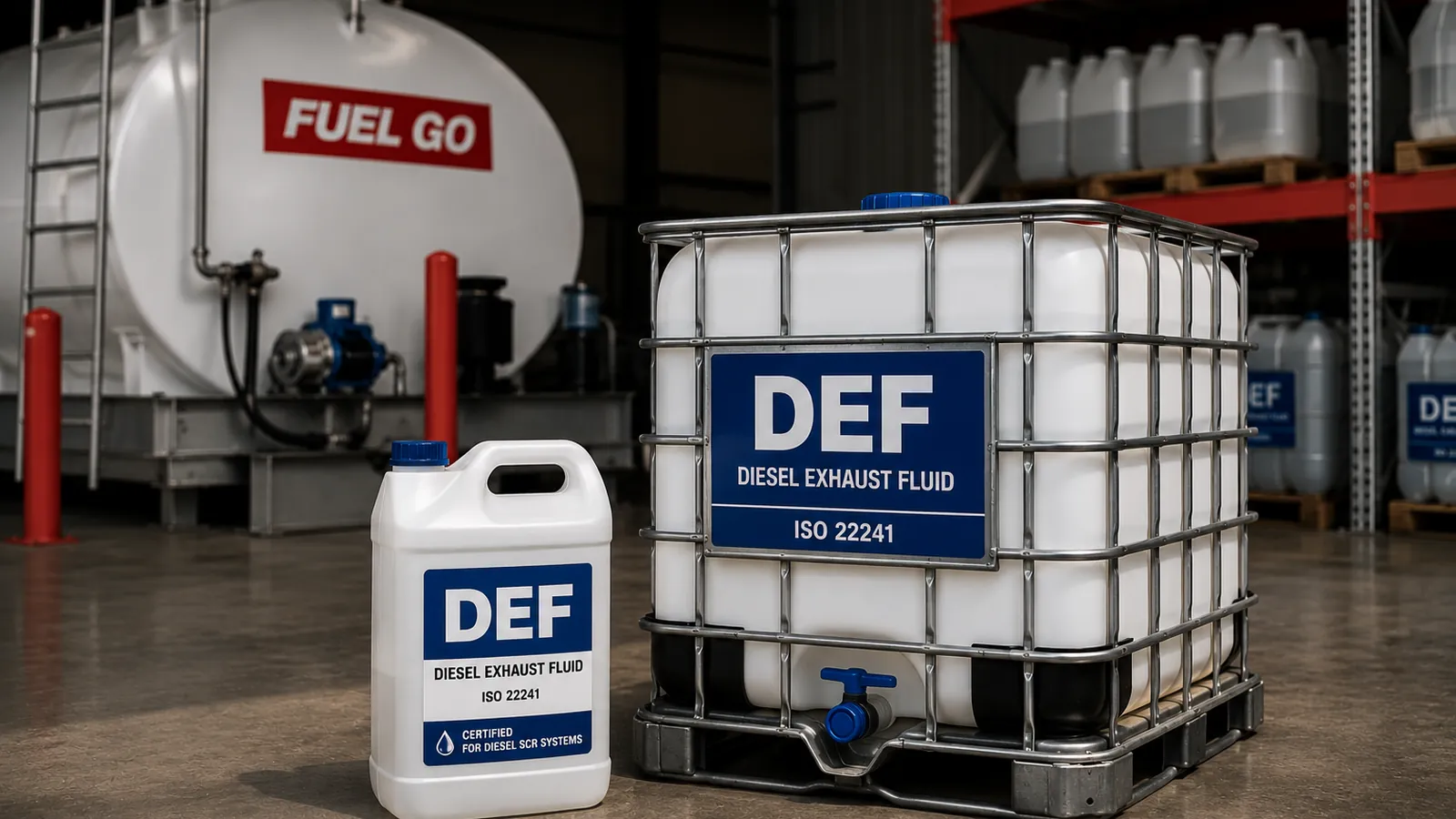
If you own or operate a newer diesel truck or a piece of diesel-powered equipment, it may use DEF — Diesel Exhaust Fluid — as part of its emissions system. DEF is not a fuel additive, and an empty tank can trigger warnings and progressive performance limits on many SCR-equipped engines. FuelGo can coordinate DEF with on-site diesel delivery so both supplies arrive at your operation.
This guide explains exactly what DEF does inside your engine, what happens when it runs low, how much you'll burn through, and how to handle and store it properly. No fluff, no filler — just the technical reality.
DEF (Diesel Exhaust Fluid) is a solution of 32.5% high-purity urea and 67.5% deionized water that's injected into the exhaust stream of SCR-equipped diesel engines. Through Selective Catalytic Reduction (SCR), it helps convert harmful nitrogen oxides (NOx) into nitrogen and water vapor. Nearly all on-road diesel trucks produced since 2010 and many newer nonroad machines use DEF, but requirements vary by engine family, power rating, and model year.
What DEF actually is (and isn't)
DEF is one of the simplest fluids on your vehicle. It's manufactured to the international standard ISO 22241, which specifies exactly what goes into it and how pure it must be.
Deionized waterStandard water won't work — minerals would clog the SCR system. ISO 22241 requires ultra-pure deionized water.
Automotive-grade ureaSynthetic urea produced from ammonia and CO₂. Same molecule found in fertilizer, but at much higher purity.
Critically, DEF is not a fuel additive. It never enters your fuel system, never mixes with diesel, and never touches the engine itself. It lives in a completely separate tank, with a separate cap (typically blue), and is injected only into the exhaust stream — well after combustion has happened.
DEF is also not hazardous in its standard form. It won't burn, won't poison you on contact, and isn't classified as a dangerous good for transportation. The biggest handling risks are corrosion (DEF will corrode certain metals like aluminum, copper, and brass) and contamination — a few drops of diesel or oil in a DEF tank can damage the SCR system enough to require thousand-dollar repairs.
The Selective Catalytic Reduction (SCR) process
When diesel burns inside an engine cylinder, the high combustion temperature produces nitrogen oxides — NOx. These gases contribute to smog, acid rain, and respiratory illness, and they're tightly regulated by EPA standards. The SCR system is the mechanism that removes them, and DEF is the working fluid that makes SCR work.
Combustion
Diesel burns, producing NOx, CO₂, water vapor, and particulates
DEF Injection
Precise dose of DEF sprayed into the hot exhaust stream
Thermolysis
Heat breaks DEF down into ammonia (NH₃) and CO₂
Catalyst Reaction
NH₃ reacts with NOx over the SCR catalyst
Clean Output
Harmless N₂ gas and H₂O vapor exit the tailpipe
The reaction is precisely controlled by the engine's electronic control unit (ECU), which monitors exhaust temperature, NOx sensors, and engine load to inject exactly the right amount of DEF — typically around 2–3% of fuel consumption by volume. Too little and emissions exceed legal limits; too much and the system produces ammonia slip (unreacted NH₃) that triggers fault codes.
When the SCR system is working correctly, it can sharply reduce NOx emissions while allowing the engine to operate efficiently. Removing, bypassing, or tampering with certified emissions controls can violate the federal Clean Air Act and may also violate state law; penalties depend on the facts and can be substantial.
A typical low-DEF warning and inducement sequence
SCR-equipped engines monitor DEF level and system performance. Low fluid or a detected fault can trigger dashboard warnings and, on some equipment, progressive performance limits called inducements or derates. The timing, thresholds, restart behavior, and speed or torque limits vary significantly by manufacturer, engine family, application, and software version. Use the sequence below only as a planning example and follow the operator's manual for your equipment.
Initial warning
A dashboard warning light illuminates and a chime may sound. Performance is usually unaffected, but remaining range depends on tank size, duty cycle, and manufacturer calibration.
Persistent warning
Warnings become more urgent. Some systems may begin limiting performance. Refill promptly and investigate any quality or sensor warning.
Initial derate
Depending on the vehicle or machine, torque, power, or road speed may be limited. Exact behavior is manufacturer-specific.
Final inducement
Some systems may impose a severe speed or idle-only limit, or restrict restart after shutdown. Refill and follow the manufacturer's recovery procedure.
EPA requirements include driver warnings, onboard diagnostics, and tamper protection, while manufacturers determine approved inducement strategies. EPA guidance issued in 2025 and 2026 also encourages less disruptive approaches and approved software updates for certain in-use engines. Ask your dealer whether an update applies to your engine. For fleet operators, scheduled refills and tank monitoring can reduce downtime.
DEF consumption rates and refilling
DEF consumption is remarkably predictable. The SCR system uses DEF in proportion to fuel burned — roughly 1 gallon of DEF for every 50 gallons of diesel, or about 2% by volume. Some operating conditions push that higher.
For a heavy-duty truck burning 100 gallons of diesel per day, a 2–3% planning range equals about 2–3 gallons of DEF per day. Off-road equipment and generators can differ substantially by engine, load, temperature, and emissions calibration, so use the manufacturer's published consumption rate when sizing on-site supply. For critical-power applications, pair that estimate with a reliable generator fuel delivery plan.
Heavy load, high RPM, and hot ambient temperatures all increase DEF consumption. Cold weather decreases it slightly but introduces other concerns — DEF freezes at 12°F (-11°C), which is why most modern trucks have heated DEF tanks and supply lines.
How to calculate your fleet's DEF demand
For accurate ordering, multiply your monthly diesel volume by 0.025 (2.5%). A site using 10,000 gallons of diesel per month will need approximately 250 gallons of DEF per month. Round up by 15–20% to account for variability and build in safety stock.
DEF storage and shelf life
DEF degrades when stored badly. The urea concentration breaks down outside its specified range, and once degraded, the fluid won't perform correctly in the SCR system — even causing fault codes. Three factors matter most.
Temperature window
Keep DEF sealed, shaded, and within the storage range printed by its supplier. Average temperatures above 86°F (30°C) and direct sunlight accelerate degradation. DEF freezes at about 12°F (-11°C) and can expand by roughly 7%, so containers need room for expansion. On-spec DEF can be used after it thaws naturally; do not add water or aftermarket thawing additives.
Shelf life
In favorable, temperature-controlled storage, unopened DEF can remain usable for an extended period, often up to about 2 years. Heat shortens shelf life. Always follow the supplier's date code and storage guidance rather than relying on age alone.
Contamination prevention
DEF is sensitive to contamination. Even small amounts of diesel, oil, or other fluids in a DEF container will damage the SCR system. Always use dedicated DEF dispensing equipment, never reuse containers for other fluids, and store DEF in a sealed container away from direct sunlight. Discolored DEF — anything other than clear, water-like appearance — should be disposed of, not used.
How to buy DEF for your operation
DEF is sold in five common packaging formats. The right choice depends on how much you use and where you use it.
2.5-gallon jug
Available at truck stops and auto parts stores. Most expensive per gallon but convenient for individual top-offs and emergency situations.
55-gallon drum
Standard option for small commercial operations. Requires a hand pump or transfer pump. Watch for the 2-year shelf life if you turn through them slowly.
275-gallon tote (IBC)
The most popular format for medium-sized fleets and construction sites. Compatible with most DEF dispensing systems. Returnable or refillable totes are available from many suppliers.
Bulk delivery (500+ gal)
Lowest per-gallon cost. Delivered by tanker truck into a dedicated DEF storage tank on your site. Best paired with tank monitoring for automated reorder.
Related FuelGo services
DEF vs. AdBlue, AUS 32, and other names
DEF goes by several names internationally. They're all the same product — same ISO 22241 specification, same chemistry, fully interchangeable.
| Name | Region | Specification | Compatible with US DEF? |
|---|---|---|---|
| DEF (Diesel Exhaust Fluid) | United States, Canada | ISO 22241, API certified | Yes — this is the standard term |
| AdBlue | Europe, Asia, Australia | ISO 22241 (VDA trademark) | Yes — identical product |
| AUS 32 | Technical / regulatory | ISO 22241 | Yes — chemical name (Aqueous Urea Solution 32.5%) |
| ARLA 32 | Brazil, South America | ISO 22241 | Yes — same product, regional brand name |
5 expensive DEF mistakes to avoid
Putting DEF in your diesel tank
This is the most common (and expensive) mistake. DEF in the fuel system corrodes injectors, pumps, and lines. Repair costs typically run $5,000–$15,000. The blue cap on DEF tanks is deliberate — never confuse it with the diesel cap.
Filling DEF tanks with anything else
Water, urea you bought from a fertilizer store, or homemade solutions will trigger fault codes and damage the SCR catalyst. ISO 22241-certified DEF is the only acceptable input — accept no substitutes.
Trying to "delete" the DEF system
Removing SCR components or installing defeat devices can violate the Clean Air Act and state law. Penalties vary and can be substantial, and tampering may also affect warranties and resale value.
Storing DEF in the wrong container
DEF corrodes aluminum, copper, brass, and zinc. Use only stainless steel, certain plastics (HDPE), or original manufacturer containers. Never store DEF in old fuel cans.
Ignoring contaminated DEF
Yellow, brown, or cloudy DEF has either been contaminated or degraded by heat. Using it damages the SCR system. The cost of a fresh batch is far less than the cost of replacing an SCR catalyst.
Letting DEF run out on a job site
Limp mode on a construction site can shut your project down for hours. Track DEF levels alongside diesel and use scheduled bulk DEF delivery to prevent it from happening.
DEF FAQ
- DEF is 32.5% urea, 67.5% deionized water — manufactured to the ISO 22241 standard. Not a fuel additive; never touches your fuel system.
- It cleans up NOx emissions through Selective Catalytic Reduction (SCR) — converting harmful nitrogen oxides into harmless nitrogen gas and water vapor.
- Plan for ~2-3% DEF usage as a percentage of diesel consumed. A 100-gallon-per-day truck needs about 2–3 gallons of DEF daily.
- Running low triggers warnings and may lead to an inducement. The exact torque, speed, idle, and restart limits depend on the engine and its software.
- Store it sealed, shaded, and cool. Heat and contamination shorten shelf life. On-spec DEF can be used after thawing naturally.
- Match packaging to actual usage. Bulk delivery can lower unit cost for fleets that turn inventory before it ages; tank monitoring helps prevent runouts.
Sources and further reading
For current regulatory and product-quality guidance, see the U.S. EPA's Diesel Exhaust Fluid guidance and the American Petroleum Institute's DEF consumer guidance. Always follow the operator's manual and the instructions on your DEF product.