
Edge Data Center Generator Fuel: Belly Tanks, Hard Access and Many Sites
An edge site is one small generator, one small tank and usually nobody there to watch it. Fuel it with a site record, a refill trigger and a level sensor, then run every site the same way.
Many edge and modular data centers run one small diesel generator on a sub-base (belly) tank sized for about 24 to 72 hours at full load. Fueling them is a logistics job, not a volume job: record each site's fill point and access once, refill after tests and before storms, and let tank telemetry trigger deliveries across every site.
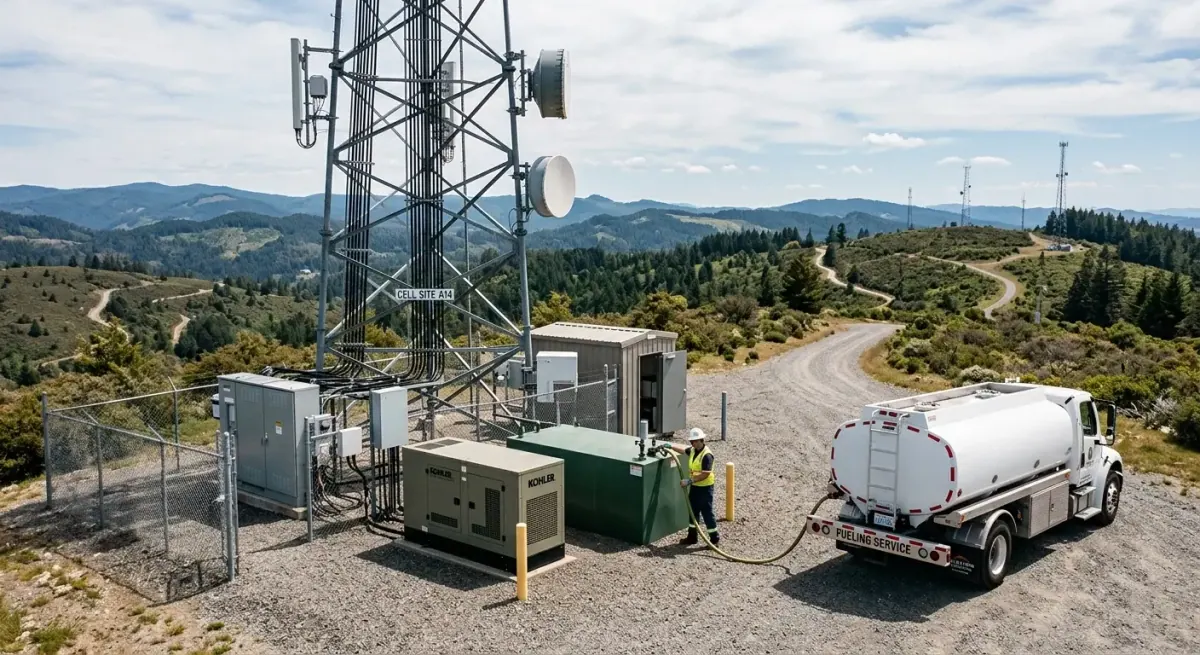
How fueling edge data centers differs from fueling a campus
There's no standard definition of an edge data center, and Sunbird notes it's hard to pin one down. Nlyte describes facilities that typically run on 5 to 10 kW, some as small as a single rack in a hospital or retail store, sited at telecom towers, on factory floors, in parking lots, on rooftops and in remote outdoor locations. Modular and prefabricated data centers come in three form factors, ISO container, non-ISO enclosure and skid, built as power, cooling or IT blocks (Schneider Electric's classification, via Data Center Knowledge). Uptime Institute's 2022 edge survey summary says power and cooling redundancy at most edge sites is likely to be N+1.
This guide is for the sites that back that up with a diesel generator. What they share is the fuel problem: Sunbird says most edge data centers are managed remotely, with little if any full-time staff. Nobody walks past the tank. That changes almost everything about how fuel gets there:
| Data center campus | Edge or modular site | |
|---|---|---|
| Fuel on site | 20 to 30 or more generators, often with tanks of 8,000 to 9,000 gallons each (see data center fuel delivery) | One set on a belly tank. On a 40–60 kW set that's 133 to 403 gallons (Kohler) |
| Runtime cushion | Sized to a runtime commitment, refilled in truckloads (sizing guide) | Typically 24 to 72 hours at full load (Generac, Global Power) |
| Delivery | Transport loads of up to 7,500 gallons, several per long outage | A small drop per site, many stops per route |
| Eyes on the tank | Operations staff, BMS and DCIM | Remote telemetry, if it was installed |
| Access | A planned truck route to bulk fill points | Gates, rooftops, parking lots, other people's buildings, gravel roads |
| Typical failure | Running short over a long outage | One forgotten site running dry, or a truck that can't reach the fill |
Belly tanks: how much fuel an edge generator carries
A sub-base or belly tank sits under the generator, inside its footprint. Global Power describes standard sub-base tanks as double-walled to UL 142, with UL 2085 versions adding a two-hour fire rating, and gives a run time of 24 to 72 hours. Generac puts typical base tanks at 24 to 72 hours at full load. Kohler's spec sheet for its 15–60 kW sets shows how small that is in gallons:
| Set | Sub-base tank | Rated hours | Kohler's estimate |
|---|---|---|---|
| 40 kW | 133 gal | 24 h | 36 h |
| 40 kW | 229 gal | 48 h | 62 h |
| 40 kW | 275 gal | 72 h | 74 h |
| 50 kW | 133 gal | 24 h | 29 h |
| 50 kW | 229 gal | 48 h | 50 h |
| 50 kW | 403 gal | 72 h | 88 h |
| 60 kW | 133 gal | 24 h | 25 h |
| 60 kW | 275 gal | 48 h | 51 h |
| 60 kW | 403 gal | 72 h | 75 h |
Kohler 15–60REOZK spec sheet G6-141, standard sub-base tanks, 60 Hz, full load ("nominal/actual" hours). Kohler's state-code tanks run to 96 hours. The sheet for your own set wins.
The cushion is small. A 133-gallon tank is about one day at full load, so in an outage a late truck means a dark site by tomorrow. Bigger sets carry bigger tanks: our consumption chart puts a 500 kW set at 25.1 gallons an hour at 75% load, about 40 hours on 1,000 usable gallons. Plan from usable fuel, not the nameplate, because the pickup sits above the tank floor.
The fuel barely moves between outages. A 60 kW set at 25% load burns 1.4 to 1.6 gallons an hour (same chart). If it exercises for an hour a month at light load, a year of tests uses under 20 gallons, less than 15% of a 133-gallon tank. The rest can sit for years.
BP's storage guidance: keep tanks full to reduce the space for water to condense. A tank kept half full builds up more water and corrodes in its top half, and most water comes from condensation as the tank breathes, more so in hot, humid coastal areas. A belly tank that turns over this slowly needs sampling and, when tests call for it, polishing. Schedule and tests: data center fuel quality program. Shelf life: how long diesel lasts.
Belly tanks sit outdoors above ground, so their fuel gets as cold as the air. A tank filled in summer still holds summer fuel in January. Check its cloud point before winter (preventing diesel gelling). How sub-base tanks compare with other storage is in aboveground vs. underground tanks.
AccessFill points and access: where edge deliveries fail
Volume is rarely the hard part at an edge site. Getting the hose onto the right fill, at an hour when someone can open the gate, is. The tank side of that is on the spec sheet. Kohler's sub-base tanks come with a lockable fill cap on a riser, a fuel level sending unit and a leak detection switch. Options include a 5-gallon spill container (with or without a 95% shutoff), a fill pipe extended to within 6 inches of the tank bottom, a high fuel level switch and a decal showing the tank number and safe fill height. Where the fill point sits away from the tank, the fuel system adds remote fill spill containers and fill line piping (Franklin).
Two very different deliveries
Some rooftop sets carry their own belly tank on the roof. Others draw from storage lower in the building, and fill stations can deliver fuel to rooftop systems from building tanks, underground tanks or straight from the truck (Earthsafe). Find out which you have before the first order: it decides hose reach, pumping and who has to be on the roof.
Container and enclosure modules
The truck needs a lane to the fill and somewhere to stand without blocking traffic. Mark it on the site plan, and keep it clear of snow piles, dumpsters and parked cars. A module added later can box in a fill that used to be easy.
Gravel roads and locked compounds
Gate codes, road limits, check-in rules and seasonal access belong in the site record, not in one technician's phone. Tower networks run the same way; see telecom generator fueling.
Racks in hospitals, stores and offices
A single rack in a host building may ride on the host's generator. Find out whose generator backs it up, who orders its fuel, and whether anyone tells you when the level is low.
The site record: one row per site
Every failed edge delivery traces back to something nobody wrote down. Record it once, keep it current, and share it with the supplier:
| Field | What to record | Why it matters |
|---|---|---|
| Site ID and location | Your site ID, street address, and a map pin for sites without a clear address | The driver needs the pad, not just the street |
| Access | Gate codes, check-in steps, escort rules, delivery windows, a contact who answers after hours | A truck that leaves a locked gate costs a day |
| Truck position | Where the truck parks, hose distance to the fill, fill height above the truck | Decides hose length and whether the fill needs pumping |
| Fill point | At the tank or remote, fitting type, spill container, overfill device | The wrong fitting is a failed drop |
| Tank | Capacity, safe fill height, usable gallons, level sensor | Sets the order size and the refill trigger |
| Product | Dyed off-road, clear on-road or R99 where approved | Portfolios often mix products by site |
| Records | Who gets the ticket, the site PO or cost center | Per-site billing and reconciliation |
Keep-full programs for many small sites
Generac's point about on-site diesel applies to every site you add: someone has to keep the tank full and schedule the deliveries. One site is easy. Two hundred are a routing problem. The answer is to make every site run the same way:
- Build the site list once. One record per site, as above, kept by your team and your supplier.
- Put a level sensor on every tank. At an unstaffed site, telemetry is the only reading you get between visits. Sensor types and alarms: data center fuel monitoring.
- Set the refill trigger in hours, not percent. Hours left at expected load must cover the delivery window for that site, which is longer at remote sites. How to build it: reorder points.
- Top off after tests and load-bank runs. Whatever a test burns comes out of a small cushion.
- Top off before storms, by forecast area, starting with the sites that matter most. The sites that stay up in a long outage are the ones that started full.
- Put fuel quality on a cycle. Slow turnover means sampling, not just volume, per the fuel quality program.
- Keep records by site. Gallons, date and tank for every fill, so deliveries reconcile against run hours and the contract (keep-full terms).
| Refill model | How it works | Fits | Watch for |
|---|---|---|---|
| Scheduled keep-full | A fill frequency agreed from the test schedule and consumption history | Sites with predictable draw | A calendar doesn't see an unplanned run |
| Monitored refills | A sensor reports the level to you and the supplier; refills trigger on actual consumption | Remote and unstaffed sites | A sensor offline means the level is unknown |
| Operations-center requests | Your NOC watches levels and requests fuel as needed | Teams that already monitor centrally | Someone has to place the order at 2 a.m. |
Most portfolios end up on a mix: monitored refills on the remote sites, a schedule where draw is predictable, and emergency response on file for all of them.
When one storm hits every site at once
An illustration, not a benchmark: 100 edge sites, each a 60 kW set on a 133-gallon tank, all on generator at 75% load. At 3.6 to 3.8 gallons an hour each (our chart), the portfolio burns 360 to 380 gallons an hour, or 8,600 to 9,100 gallons a day. That's more than a 7,500-gallon transport every day, delivered as 100 small drops instead of one. Each tank lasts about 35 to 37 hours on paper, less after the fuel below the pickup, so in a two-day outage every site needs a truck.
Start full
Top off every site in the forecast area while roads are open and trucks are free. Fuel already in the tank doesn't need a truck during the storm.
Rank the sites
Agree in advance which sites get fuel first. When every tank is draining, the order of stops decides which sites stay up.
Add tank where it counts
An auxiliary tank feeding the generator's own tank turns a one-day site into a multi-day one. See fuel tank rentals.
Plan the cadence
Delivery cadence, access and staging for long outages: extended outage fuel planning.
Which fuel for edge generators
- Dyed off-road diesel is the usual fuel for a stationary generator, because it never touches a public road. Clear diesel is needed where fuel could reach a road vehicle, such as a shared fill point or a road-registered towable set. See off-road diesel delivery.
- R99 renewable diesel is a drop-in replacement with no engine modifications. Confirm with your generator maker first. R99 isn't at every terminal; where it can't be pulled locally it ships by rail or barge, which matters when sites are spread across regions. See renewable diesel for data center generators.
- One product per tank. Record the grade in the site record so a driver covering a new route doesn't guess.
Edge and modular sites on one FuelGo account
FuelGo serves enterprise, colocation, cloud, hyperscale and edge data centers. For a network of small sites, setup follows our tower network model: send the site list (locations or site IDs, tank sizes, fill types and access notes), and check-in procedures, gate codes and security protocols are recorded before the first visit. Fills then run on a schedule, on your operation center's requests or on monitored levels. Gallons are itemized by site and date, with consolidated billing across the network and invoicing through ARIBA or COUPA if you use them.
On monitored tanks you see the level on your phone, and so do we, and refills trigger on actual consumption. We schedule fills around your tests and load-bank runs and top off generators ahead of forecast storms. Rooftop sets, gated compounds and remote sites are routine: access, hose reach and fill-point specifics are confirmed before a truck is assigned. Wet-hose fueling reaches remote generator locations, and where a belly tank is too small we rent an auxiliary tank, plumb it to feed the generator's own tank and keep it full, with rental tanks from 119 to 17,000 gallons.
We deliver generator fuel at 20 to 4,400 gallons per drop, from a single generator top-off up to transport loads of 7,500 gallons: dyed off-road, clear on-road and R99 renewable diesel. Fuel polishing covers tanks from 50 to 50,000 gallons, with lab fuel testing. Dispatch is staffed 24/7/365, critical facilities like data centers are prioritized in emergency dispatch, and customers with site details on file are dispatched first. For sites across many states, our vendor network delivers wherever your infrastructure is. Get a delivered quote or call 800-720-4546; a dispatcher replies within the hour.
Common questionsEdge data center generator fuel FAQ
How do you fuel an edge data center generator?
How big is the belly tank on an edge data center generator?
How long will a belly tank run an edge generator in an outage?
How often should edge generator tanks be refilled?
How do you refuel a rooftop generator at an edge site?
How do you manage generator fuel across hundreds of edge sites?
Does diesel go bad in a small generator tank that rarely runs?
Does FuelGo fuel edge and modular data centers?
Sources: Generac, Eliminate bulky fuel storage (base tanks 24–72 hours at full load; keeping tanks full and scheduling deliveries) · Kohler 15–60REOZK enclosure and sub-base tank spec sheet G6-141 (tank gallons and full-load hours; UL 142; fill, spill, 95% shutoff, high-level switch and safe fill height options; state-code tanks to 96 hours) · Global Power, Generator sub-base fuel tanks and state UL listings (double-wall UL 142; UL 2085 two-hour rating; 24–72 hours) · Nlyte, What is an edge data center?, July 2025 (5–10 kW; single rack; towers, parking lots, rooftops) · Sunbird, 4 key characteristics of edge data centers (no standard definition; managed remotely with little full-time staff) · Uptime Institute, Edge Data Center Survey 2022 summary (N+1 at most edge sites) · Data Center Knowledge, Understanding the types of prefabricated modular data centers (Schneider Electric form factors and functional blocks) · Franklin, Generator fuel oil supply systems (remote fill spill containers, fill line piping) · Earthsafe Systems overview (fill stations delivering fuel to rooftop systems) · BP Australia, Long term storage of diesel (keep tanks full; condensation and water build-up). Burn rates are from our generator fuel consumption chart; campus tank sizes and FuelGo service details are from our service pages.