
Aboveground vs. Underground Diesel Tanks: Which Fits Your Site?
Aboveground is cheaper to put in, easier to inspect and can move with the job. Underground saves the surface and keeps fuel out of the weather, but you can't see what it's doing.
For most commercial sites, an aboveground tank (AST) is the better fit: it costs less to install, you can see a leak, and it can move when the job does. An underground tank (UST) makes sense when surface space is scarce, the site is permanent, and you want fuel shielded from weather, traffic and theft, and accept harder inspections.
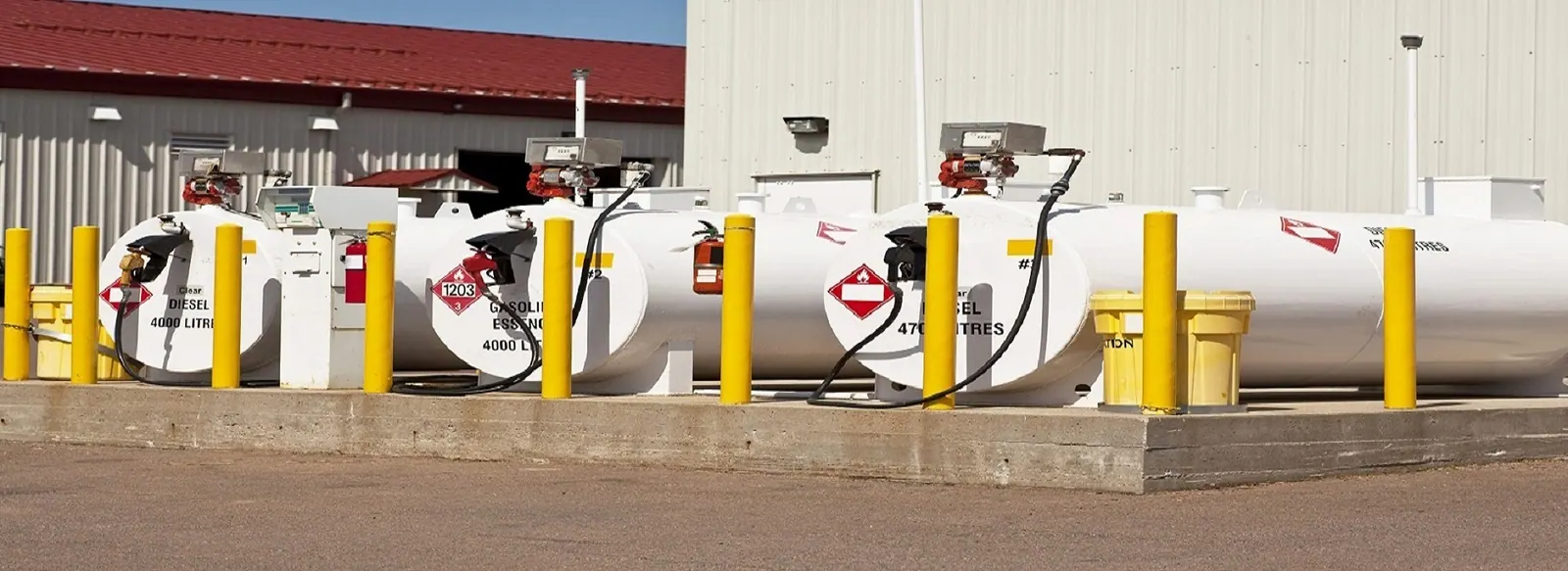
Aboveground vs. underground fuel tank: the short comparison
An AST sits on or above the ground. EPA counts a tank system as a UST when at least 10% of its combined volume, including connected underground piping, is below ground. Generator sub-base tanks, skid tanks, fuel cubes and towable tanks are all ASTs. Here's how the two compare on the things that decide a site.
| Factor | Aboveground (AST) | Underground (UST) |
|---|---|---|
| Upfront cost | Lower. Minimal excavation. | Higher. Vendors put installation 15–25% above a comparable AST. |
| Surface space | Takes yard space plus clearance around it. | Surface stays usable for parking or driveways. |
| Seeing a leak | Walk around it and look. Repairs are quicker and cheaper. | Releases and corrosion can go undetected. Needs monitoring equipment. |
| Fuel temperature | Follows the air, day and night, summer and winter. | Stays around 35–45°F or warmer in winter. Fewer daily swings. |
| Water | Daily temperature swings make the tank breathe humid air. | ASTM D975 says the water contamination risk can be greater. |
| Theft, vandalism, impact | Higher exposure. Plan on locks, lighting and bollards. | Less visible and harder to reach. The fill still needs a lock. |
| Moving it | Portable, skid and towable units move. Many can be rented. | Essentially permanent once installed. |
| Best fit | Job sites, yards, farms, generators, anything temporary | Permanent, space-tight sites with steady demand |
Sources for each row are discussed below and listed at the end of the page.
CostUpfront and installation cost drivers
Nobody independent publishes a national price for installing either type, and site work swings the number more than the tank does. What the sources agree on is direction. Alberta Agriculture's farm fuel guide calls AST installation "slightly less expensive." Two tank companies, Commercial Tank and Mass Tank, put underground installation at about 15–25% more than a comparable aboveground tank. "Slightly" and "15–25%" aren't the same answer, so treat the gap as site-specific and get quotes for both.
You're paying for the hole
- Excavation, backfill and hauling soil. Alberta lists "extensive excavation" as a UST drawback.
- Buried piping and sumps that are hard to reach later.
- Leak detection equipment and its upkeep, because you can't see the tank.
- Repairs dig up the site. Alberta: repairs are "more difficult and expensive."
You're paying for the surroundings
- A level pad and room around the tank.
- Protection from vehicles: bollards and fencing (Commercial Tank recommends both).
- Weather wear. Commercial Tank suggests repainting steel ASTs every 5–10 years.
- Or skip ownership: a rental tank moves the purchase off your books.
Size the tank before you price it. Our storage tank size calculator turns daily burn and delivery interval into usable capacity, so you're not paying to bury or pour a pad for gallons you'll never use.
SpaceSpace and footprint
This is the one category underground clearly wins. A UST's surface can carry parking or a driveway (Commercial Tank, Western Global). An AST takes yard space, plus clearance from buildings and property lines, plus room for a truck to pull up to it. Alberta also lists "can be aesthetically undesirable," which matters at a storefront, campus or hospital entrance more than at a quarry.
On a tight urban lot, that trade can decide everything. On a farm, a laydown yard or a highway job, it rarely does.
Leaks & inspectionLeak visibility and how easy inspection is
An aboveground tank "can be visually monitored for leaks or corrosion, allowing for an effective response," and its repairs "are quick and less expensive" (Alberta Agriculture). Western Global notes no specialized equipment is needed to spot an AST leak, while underground monitoring "requires specialized monitoring equipment and is often less immediate."
The underground risk is what you don't see. In EPA's study of diesel USTs, 35 of 42 (83%) showed moderate or severe corrosion inside, and fewer than 25% of owners knew before the internal inspection. When a UST does leak, EPA's concern is fuel seeping into soil and groundwater. For what an internal inspection involves, see fuel polishing vs. tank cleaning.
Cold weatherFuel temperature and gelling
Ground temperature is underground's best argument. Fuel in an AST follows the air. Untreated #2 diesel starts to cloud at about 6–14°F (what temp does diesel gel?), and an exposed tank gets there on any hard cold night.
- Underground stays warmer. Cenex puts underground temperatures at 35–45°F, enough to keep fuel above its cloud point. NREL says underground storage temperatures are "normally above" 45°F. The two differ a little, but both sit well above #2's cloud point.
- Summer heat counts too. ASTM D975 prefers underground storage "to avoid temperature extremes" and says aboveground tanks should be sheltered or painted with reflective paint, because high storage temperatures may speed fuel degradation. See how long diesel lasts.
- The tank isn't the whole system. Pumps, lines and dispensers above ground still need protection from cold and wind (NREL), and Alberta warns buried piping can break under freeze-thaw stress.
- ASTs can be winterized. Winter fuel, anti-gel added before the cold, and a fall water check do the job. See how to prevent diesel gelling.
Condensation and water: each type has its own problem
This is where the "underground is better" story gets more complicated. ASTM D975 says underground tanks are preferred "to minimize diurnal temperature swings," then adds that "there can be a greater risk of water contamination in underground tanks."
Breathing and condensation
Daily heating and cooling pushes air out and pulls humid air back in. Cenex notes tanks "can breathe in large volumes of humid air" as fuel is drawn down. D975's fix: keep tanks full to limit breathing.
Water you can't see coming in
Fewer temperature swings, but a buried tank can take on water you won't notice without sticking it. Check the bottom regularly, at both ends. See keeping water out of diesel.
Either way, water drives corrosion and microbial growth at the fuel-water interface (D975). Drain it on a schedule, and if it's already there, fuel polishing and testing deal with the fuel.
SecurityTheft, vandalism and vehicle damage
Alberta lists "increased risk of vandalism or accidental vehicular collision" as an AST drawback. Western Global calls underground tanks "less visible and less accessible to tampering or theft." That's real, but a UST isn't theft-proof: its fill and any dispenser are still at grade. Lock both.
For an AST, the basics are a locked fill and pump cabinet, a pump that's off after hours, lighting, bollards, and logging every gallon. On rental tanks, PIN or key-fob fuel management records who drew fuel and how much. The full playbook is in construction site fuel theft.
DeliveriesAccess for delivery trucks
Whatever you install, a truck has to reach the fill. Plan it before the concrete goes in:
- Where the truck parks. A UST fill is usually at grade in the lot, so the truck parks on top of the space you saved. Pick a spot that doesn't block a lane or a loading door during a drop.
- How high and how far. An AST fill may sit at the top of the tank. Tell the supplier the height and the distance from where a truck can stop.
- Gates and hours. Locked yards and limited hours decide when you can be filled, which matters most when you're running low.
- Gauge before and after. Check the tank level against the ticket. See how to read a fuel delivery ticket.
Lifespan and corrosion
There's no reliable single number for how long either type lasts. It depends on the material, the coating, how much water sits in the bottom and how well the tank is kept. What the sources do say:
- Buried steel is the corrosion risk. Alberta lists "greater corrosion risk for steel tanks and piping" underground. EPA's 35-of-42 finding was in diesel USTs.
- Non-metallic tanks don't rust. Commercial Tank notes that nylon, HDPE and fiberglass-reinforced composite "will not rust or corrode."
- ASTs wear from the outside. Weather adds wear (Alberta), and steel ASTs need repainting every 5–10 years (Commercial Tank). The upside: you can see it and fix it.
- Water shortens both. D975: "Water promotes corrosion." Draining it is the cheapest life extension there is.
Temporary vs. permanent sites
If the site has an end date, the decision is made: aboveground. Western Global calls USTs "essentially permanent once they are installed," while ASTs "can be easily transported." For a road job, a solar build, a plant shutdown or a one-season farm need, burying a tank makes no sense.
FuelGo rents double-walled tanks from 119 to 17,000 gallons: portable, skid, fire-rated, DEF and towable. They're delivered set up, level and pumped, filled on the first visit, with rental and refills on one invoice. Portable and towable tanks are built to move with forklift pockets or a hitch; skid units can be relocated with equipment and notice. See fuel tank rental.
GeneratorsGenerator sub-base and belly tanks are ASTs
Most standby generators already sit on an aboveground tank. Georgia's GEFA generator fuel guidelines describe a sub-base tank as a rectangular double-wall design, a steel inner tank inside a steel secondary tank, installed below the generator set between the foundation pad and the generator. Those same 2012 guidelines show where one program drew the line: generator tanks of 1,000 gallons or less were to be sub-base ASTs, and larger systems were to use USTs.
A sub-base tank buys you hours. If the job needs days, or the set runs prime power, an auxiliary or day tank alongside it changes the delivery schedule. FuelGo rents those tanks, plumbs them to feed the generator's own tank and keeps them full. Work out runtime with the generator fuel calculator, and see generator fuel delivery and emergency fuel planning for facilities.
Moving & removalMoving or removing a tank
Aboveground: draw the tank down before the move. A full tank is heavy, and hauling fuel on the road has its own limits (see how much fuel you can transport without hazmat). Then lift or tow it. With a rental, tell dispatch up front if the tank will follow the work.
Underground: it doesn't move. Taking one out means excavation and a formal closure, which is part of the rules below. Factor that end-of-life cost into the decision at the start.
RulesA note on rules
Underground tanks carry federal EPA UST requirements, including showing that the owner can pay for a cleanup "through insurance or other means," plus state and local rules. States run most UST programs and can be stricter, and some tanks excluded federally may still be covered by the state. Aboveground tanks have their own requirements. Check with your state tank program and local fire authority before you choose; our storage regulations guide has the details. This is not legal advice.
DecisionWhich tank should you choose?
Flexibility and visibility matter most
- The site is temporary, or might move
- You want to see the tank and fix problems fast
- You have room for the tank, clearance and a truck
- It's a generator, job site, yard or farm
- You'd rather rent than own
Space and permanence matter most
- The surface has to stay usable
- The site is permanent with steady demand
- Winter cold or summer heat is a real fuel problem
- An exposed tank would invite theft or vehicle hits
- You'll fund monitoring and the eventual removal
Fuel delivered to the tank you choose
FuelGo delivers dyed off-road and clear on-road diesel, gasoline, DEF and R99 renewable diesel nationwide into the storage you already run: underground, aboveground, skid or rental tanks. That's 20 to 4,400 gallons per drop, and transport loads up to 7,500 gallons, through bulk fuel delivery. Add tank monitoring to a rental tank and refills trigger on real consumption.
Fuel polishing, tank cleaning, fuel pump-out and lab fuel testing deal with water and contamination in stored fuel. Dispatch runs 24/7/365, and a dispatcher replies within the hour. Get a delivered quote or call 800-720-4546.
Common questionsAST vs. UST diesel tank FAQ
What is the difference between an aboveground and an underground fuel tank?
Is an aboveground or underground fuel tank cheaper to install?
Does diesel gel faster in an aboveground tank?
Which gets more water, an aboveground or an underground tank?
Are underground fuel tanks safer from theft?
Is a generator sub-base tank aboveground or underground?
Can I rent an aboveground diesel tank for a temporary site?
Sources: U.S. EPA, Learn about underground storage tanks · U.S. EPA, Dollars and Sense: financial responsibility for USTs · U.S. EPA, corrosion in diesel USTs (2016) · ASTM D975-24, Appendix X3.6 (NCWM copy) · Cenex, 2023 Winter Fuels Products & Best Practices for Handling · NREL, Biodiesel Handling and Use Guide (6th ed.) · Alberta Agriculture, farm fuel storage systems (Agdex 769-1) · GEFA, Generator Fuel System Guidelines (2012) · Western Global, above ground vs. underground fuel tanks · Commercial Tank, USTs vs. ASTs · Mass Tank, underground vs. aboveground storage tanks