
Diesel Fuel Storage Regulations by State: The Definitive Guide
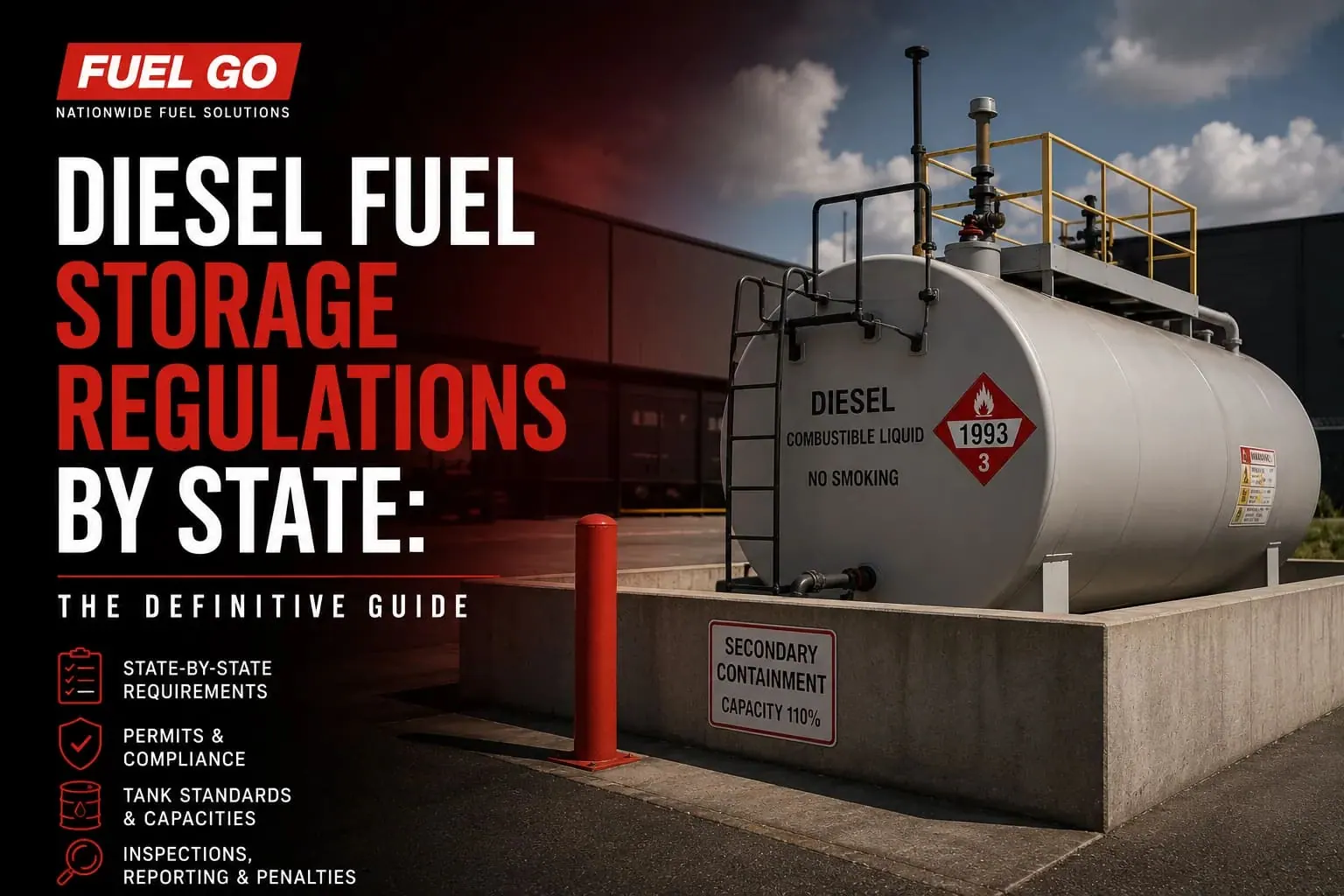
If you store diesel — for backup generators, construction equipment, a fleet yard, or a farm — you sit at the intersection of several overlapping regulatory regimes. The good news is that the structure is consistent nationwide, even though the specific numbers can differ locally. Once you understand the layers, compliance becomes a checklist rather than a mystery.
How diesel storage regulation is layered
Diesel fuel storage in the US is governed at three levels, stacked on top of each other:
- Federal — EPA (spill prevention and underground tanks), OSHA (workplace safety), and DOT/PHMSA (transport). These apply in every state.
- State — a state environmental agency typically administers aboveground/underground tank registration, spill rules, and often implements the federal UST program. A state fire marshal adopts a fire code.
- Local (AHJ) — counties and municipalities adopt and sometimes amend the fire code, issue permits, and conduct inspections. The local Authority Having Jurisdiction often has the final say on your specific site.
The single most important principle
You must satisfy the most stringent rule that applies to your site. A local fire code amendment can be stricter than the federal baseline — never assume the federal threshold is the whole story. When two rules conflict, the stricter one wins.
The federal baseline (applies in every state)
Three federal frameworks do most of the heavy lifting. These are nationally uniform, which makes them the right place to start regardless of where you operate.
1,320 gal
Aggregate aboveground oil storage that can trigger an EPA SPCC plan
42,000 gal
Completely buried storage threshold under SPCC
110%
Common secondary containment sizing (largest tank + margin)
SPCC: the 1,320-gallon trigger
The EPA's Spill Prevention, Control, and Countermeasure (SPCC) rule (40 CFR Part 112) is the one most diesel storage operators encounter first. Diesel counts as "oil" under this rule. An SPCC plan is generally required if both of these are true:
- Your facility's aggregate aboveground oil storage capacity exceeds 1,320 US gallons (counting only containers of 55 gallons or larger), or your completely buried storage exceeds 42,000 gallons; and
- There is a reasonable expectation that a discharge could reach navigable waters or adjoining shorelines; and
- the facility is non-transportation-related.
These three criteria and thresholds are stated directly by the EPA. Source: EPA — "Who is regulated by the SPCC Rule?"
An SPCC plan documents your containment, inspection, and spill-response measures. Smaller "qualified facilities" may be able to self-certify a streamlined plan (Tier I/Tier II) rather than having a Professional Engineer certify it — for example, Tier I generally applies where no single aboveground container exceeds 5,000 gallons and aggregate aboveground storage is at or below 10,000 gallons, with a clean discharge history. Secondary containment — often sized around 110% of the largest container's volume plus a margin for precipitation — is a central SPCC requirement.
Worth knowing
The 1,320-gallon threshold is an aggregate, not a per-tank number. Four 500-gallon day tanks (2,000 gallons total) can put you over the line even though no single tank is large. Count everything 55 gallons and up across the whole facility.
Underground tanks (UST) rules
If 10% or more of your tank-and-piping volume is underground, you're likely in Underground Storage Tank territory under EPA's RCRA Subtitle I program (40 CFR Part 280), almost always administered by your state. UST requirements are significantly more involved than aboveground rules and typically include:
- Tank registration with the state
- Spill, overfill, and corrosion protection
- Release (leak) detection and monitoring
- Periodic testing and walkthrough inspections
- Financial responsibility (proof you can cover cleanup costs)
Common exclusions include certain small tanks (110 gallons or less), farm and residential motor-fuel tanks at or below 1,100 gallons used for non-commercial purposes, and heating-oil tanks used for consumptive use on the premises — but exclusions are specific, so verify yours. Source: EPA — Frequent Questions About Underground Storage Tanks.
Key 2015 change — relevant to generators
USTs storing fuel solely for emergency generators are no longer deferred. The 2015 federal UST rule removed that exemption, so underground generator-fuel tanks are now fully regulated, including release detection. If you run underground diesel for backup power, confirm current UST obligations with your state agency. Note too that No. 2 diesel is not classified as "heating oil," though it counts as a heating-oil substitute when used for heating.
Because aboveground tanks avoid most UST obligations, many diesel operators favor aboveground tank rental for job sites and yards. Note that states are the primary implementers of the UST program and may impose requirements more stringent than the federal baseline — always confirm with your state agency.
Fire codes: NFPA 30 & the IFC
Diesel's fire classification matters. With a flash point typically well above 100°F, diesel is generally a Class II combustible liquid — less volatile than gasoline (a flammable liquid), but still regulated. Two code families govern storage:
- NFPA 30 — the Flammable and Combustible Liquids Code, covering tank design, separation distances, and spill control. NFPA 37 addresses stationary combustion engines such as generators.
- International Fire Code (IFC) — adopted (often with local amendments) by the majority of US jurisdictions; its flammable/combustible liquids provisions cover aboveground tank limits, spill control, and separation.
Which code — and which edition — applies depends on what your state and local AHJ have adopted. This is why two sites in different counties of the same state can face different requirements. Always confirm the adopted code and edition with your local fire marshal.
OSHA & workplace storage
For workplaces, OSHA regulates flammable and combustible liquid storage under 29 CFR 1910.106 (general industry) and 29 CFR 1926.152 (construction). These cover container limits, storage cabinets, ventilation, and handling practices. On construction sites in particular, the OSHA construction standard sits alongside the fire code and SPCC requirements — see our related guidance for construction site fueling.
The 5 questions that determine your requirements
Rather than memorizing every rule, answer these five questions for your specific site. The answers point you to exactly which regulations apply.
QUESTION 1
Above ground or below ground?
Underground (≥10% buried) generally pulls you into the far more demanding UST program. Aboveground storage is governed mainly by SPCC and fire codes.
QUESTION 2
What's your total aboveground capacity?
Add up every container 55 gallons and larger. Over 1,320 gallons aggregate, SPCC likely applies (if a discharge could reach water).
QUESTION 3
Could a spill reach water?
SPCC hinges on a reasonable expectation of discharge to navigable waters. Proximity to storm drains, ditches, and waterways matters.
QUESTION 4
Which fire code has your AHJ adopted?
IFC or NFPA, and which edition — confirm with your local fire marshal. This sets separation distances, spill control, and permit needs.
QUESTION 5
Does your state require tank registration?
Many states require AST and/or UST registration with the state environmental agency, sometimes with fees and periodic renewal. Confirm directly.
State agency directory
The federal frameworks above apply everywhere; the specifics — registration, fees, fire-code edition, and amendments — are set by the agencies below. Use this as a starting directory for who to contact, then confirm current requirements directly with each agency and your local AHJ.
| State | Typical lead environmental / tank agency | Also confirm with |
|---|---|---|
| Alabama | ADEM | State Fire Marshal · local AHJ |
| Alaska | ADEC | State Fire Marshal · local AHJ |
| Arizona | ADEQ | State Fire Marshal · local AHJ |
| Arkansas | Arkansas DEQ (Div. of Environmental Quality) | State Fire Marshal · local AHJ |
| California | CalEPA / State Water Board / local CUPA | CAL FIRE / OSFM · local AHJ |
| Colorado | CDPHE (and CO Div. of Oil & Public Safety for tanks) | Div. of Fire Prevention & Control · local AHJ |
| Connecticut | CT DEEP | State Fire Marshal · local AHJ |
| Delaware | DNREC | State Fire Marshal · local AHJ |
| Florida | FDEP | State Fire Marshal · local AHJ |
| Georgia | Georgia EPD | State Fire Marshal · local AHJ |
| Hawaii | Hawaii DOH | State Fire Council · local AHJ |
| Idaho | Idaho DEQ | State Fire Marshal · local AHJ |
| Illinois | Illinois EPA (USTs via Office of State Fire Marshal) | Office of State Fire Marshal · local AHJ |
| Indiana | IDEM | State Fire Marshal · local AHJ |
| Iowa | Iowa DNR | State Fire Marshal · local AHJ |
| Kansas | KDHE | State Fire Marshal · local AHJ |
| Kentucky | KY Energy & Environment Cabinet | State Fire Marshal · local AHJ |
| Louisiana | LDEQ | State Fire Marshal · local AHJ |
| Maine | Maine DEP | State Fire Marshal · local AHJ |
| Maryland | MDE | State Fire Marshal · local AHJ |
| Massachusetts | MassDEP | Dept. of Fire Services · local AHJ |
| Michigan | EGLE | Bureau of Fire Services · local AHJ |
| Minnesota | MPCA | State Fire Marshal · local AHJ |
| Mississippi | MDEQ | State Fire Marshal · local AHJ |
| Missouri | Missouri DNR | State Fire Marshal · local AHJ |
| Montana | Montana DEQ | State Fire Marshal · local AHJ |
| Nebraska | NDEE | State Fire Marshal · local AHJ |
| Nevada | NDEP | State Fire Marshal · local AHJ |
| New Hampshire | NHDES | State Fire Marshal · local AHJ |
| New Jersey | NJDEP | Div. of Fire Safety · local AHJ |
| New Mexico | NMED | State Fire Marshal · local AHJ |
| New York | NYSDEC | Office of Fire Prevention & Control · local AHJ |
| North Carolina | NCDEQ | Office of State Fire Marshal · local AHJ |
| North Dakota | North Dakota DEQ | State Fire Marshal · local AHJ |
| Ohio | Ohio EPA (USTs via State Fire Marshal / BUSTR) | State Fire Marshal (BUSTR) · local AHJ |
| Oklahoma | ODEQ (USTs via OK Corporation Commission) | State Fire Marshal · local AHJ |
| Oregon | Oregon DEQ | State Fire Marshal · local AHJ |
| Pennsylvania | PA DEP | State Fire Commissioner · local AHJ |
| Rhode Island | RIDEM | State Fire Marshal · local AHJ |
| South Carolina | SC Dept. of Environmental Services (verify — formerly DHEC) | State Fire Marshal · local AHJ |
| South Dakota | SD DANR | State Fire Marshal · local AHJ |
| Tennessee | TDEC | State Fire Marshal · local AHJ |
| Texas | TCEQ | State Fire Marshal · local AHJ |
| Utah | Utah DEQ | State Fire Marshal · local AHJ |
| Vermont | Vermont DEC (ANR) | Div. of Fire Safety · local AHJ |
| Virginia | Virginia DEQ | State Fire Marshal · local AHJ |
| Washington | WA Dept. of Ecology | State Fire Marshal · local AHJ |
| West Virginia | WV DEP | State Fire Marshal · local AHJ |
| Wisconsin | WI DNR (tanks via Dept. of Safety & Prof. Services) | DSPS · local AHJ |
| Wyoming | Wyoming DEQ | State Fire Marshal · local AHJ |
| Washington, D.C. | DOEE | DC Fire & EMS / Fire Marshal · local AHJ |
Primary sources
The federal thresholds and rules in this guide were verified against the EPA's own pages:
- EPA — Who is regulated by the SPCC Rule? (SPCC three criteria; 1,320-gal aboveground and 42,000-gal buried thresholds)
- EPA — Oil Spill Prevention and Preparedness Regulations (SPCC and Facility Response Plan overview)
- EPA — Frequent Questions About Underground Storage Tanks (UST definition, exclusions, 2015 rule changes including emergency-generator tanks)
- Underlying regulations: 40 CFR Part 112 (SPCC) and 40 CFR Part 280 (UST). Fire codes: NFPA 30 / NFPA 37 and the International Fire Code, as adopted by your state and local AHJ. Workplace: OSHA 29 CFR 1910.106 and 1926.152.
Storage rules are easier when you store less
FuelGo's scheduled and on-demand delivery lets many sites keep smaller on-site tanks — simplifying compliance while staying fueled. We deliver diesel, off-road diesel, DEF, and R99 nationwide.
Talk to a fuel specialist →Frequently asked questions
At what point do I need an SPCC plan for diesel storage?
Generally when your facility's aggregate aboveground oil storage exceeds 1,320 US gallons (counting containers 55 gallons and larger) — or completely buried storage exceeds 42,000 gallons — and there's a reasonable expectation a discharge could reach navigable waters. The 1,320-gallon figure is an aggregate across the whole facility, not a per-tank limit. Confirm applicability with a qualified professional.
Is diesel a flammable or combustible liquid?
Diesel is generally classified as a Class II combustible liquid because its flash point is typically above 100°F — less volatile than gasoline, which is a flammable liquid. It's still regulated under fire codes such as NFPA 30 and the International Fire Code.
Do aboveground diesel tanks need to be registered?
It depends on your state. Many states require registration of aboveground storage tanks (ASTs) above a certain size with the state environmental agency, sometimes with fees and renewals. Underground tanks are almost always subject to registration under the federal UST program as administered by the state. Confirm with your state agency.
What is the secondary containment requirement for diesel tanks?
Under SPCC, secondary containment must generally hold the volume of the largest container plus a margin for precipitation — often implemented as roughly 110% of the largest tank's capacity. Local fire codes may impose additional containment requirements. Always design to the most stringent applicable standard.
Why do requirements differ between two sites in the same state?
Because local authorities (the AHJ) adopt and sometimes amend the fire code, issue permits, and conduct inspections. Two counties may adopt different code editions or local amendments, so identical tanks can face different requirements. Always confirm with the local fire marshal.
Who has the final say on my fuel storage setup?
Typically the local Authority Having Jurisdiction (AHJ) — usually the local fire marshal or building/fire official — for code and permitting, alongside your state environmental agency for tank registration and spill rules. When rules conflict, you must meet the most stringent one.
Related: diesel tank rental · tank size calculator · bulk fuel delivery · on-site fuel delivery · construction site fueling